Wisconsin is no stranger to big weather fluctuations; temperatures can be in the 70s one day, then plunge below freezing in a matter of hours. We experience nearly all types of weather possible: from blizzards to tornadoes, from cold Arctic blasts to Florida-like humidity.
However, large extremes in temperature and precipitation have become more of the norm in the Badger State in recent decades.
What Counts as Extreme Weather?
Weather is considered extreme when it’s far from the historical average for that location or region. More simply, it’s when the weather is way outside of normal for a place.
By that definition, what’s considered extreme varies by region. An inch of snow in Florida would be extreme, while that’s a regular occurrence in Wisconsin.
There can even be large differences within a state. Ninety-degree temperatures in Rhinelander would be exceptionally hot for northern Wisconsin, while that type of heat is seen more frequently in southern Wisconsin.
Extreme weather can be very hot or cold temperatures, heavy rain, big snowstorms, tornado outbreaks, or exceptional droughts, just to name a few.
Measuring Changes in Extreme Weather
The Wisconsin State Climatology Office has developed the Extreme Weather Index (EWI) to track weather variability in the state.
The measurement compares monthly, seasonal, or annual temperature and precipitation with the state’s historical averages.
For example, if Wisconsin experienced typical temperatures and precipitation during a month, the month’s EWI would be close to zero. However, if a month featured unusually hot temperatures and very dry conditions, the EWI for the month would be closer to its maximum of 100.
Since 1895, Wisconsin’s annual EWI has increased by 28 percent — the largest increase of any Midwestern state. Southern Wisconsin has seen the largest increase in extreme weather, whereas the northeastern region has seen smaller changes.
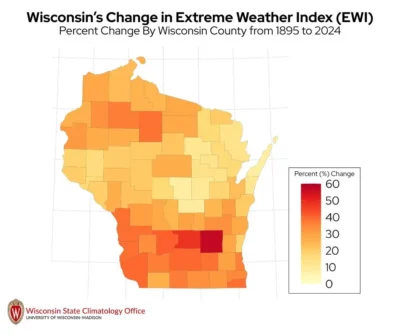
How Wisconsin’s Weather has Become More Extreme
The EWI is limited in that it only weighs the average precipitation and temperature over a month to a year, losing some of the really extreme outlier events.
We know that Wisconsin’s climate is warmer and wetter than it used to be, which fuels more extreme temperature and precipitation events.
Precipitation
Heavy rainfall events have become more common in Wisconsin since 1950. When so much rain falls in a short time, it can lead to flooded roadways and crop fields, degraded soil health, and increased runoff into lakes and streams.
Not only are extreme precipitation events occurring more frequently, but they’ve also become more intense.
Between 2010 and 2019, twenty-one extreme rainfall events occurred in Wisconsin. These events surpassed the threshold of what’s considered a 100-year event, meaning that the annual probability of that amount of rain falling in those locations was less than one percent.
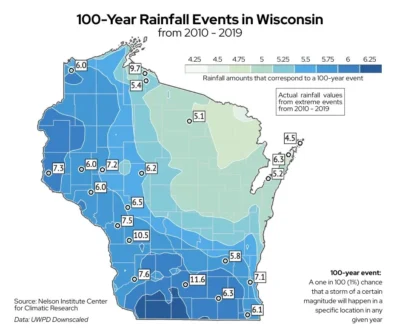
These events have occurred in nearly all areas of the state. In August 2025, a powerful storm poured a foot of rain in the Milwaukee area, setting a new state rainfall record. In August 2018, a deluge in Dane County caused major flooding west of Madison. And in 2016, torrential rains washed out numerous roads and bridges in northwest Wisconsin.
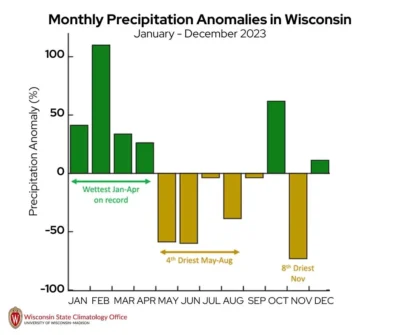
On the flip side, the state has also seen periods of major drought. How can this be if our climate is getting wetter?
Wisconsin has seen rapid shifts between very wet and very dry periods in recent years. While the amount of precipitation received has increased, its delivery more often seems to be “all or nothing.”
In 2023, Wisconsin experienced its worst drought since 2000 on the heels of the state’s wettest start to the year. This “precipitation ping-pong” has become increasingly common in Wisconsin.
Temperatures
When thinking of extreme temperatures, scorching heat likely comes to mind. Though Wisconsin is experiencing warmer daytime temperatures, there hasn’t been an increase in the number of very hot days. Since 1950, the average number of 90-degree days per year in Wisconsin has remained consistent at 10.
The most significant warming is likely happening while you’re asleep. The average number of very warm nights that Wisconsin experiences each year has nearly tripled since 1950!
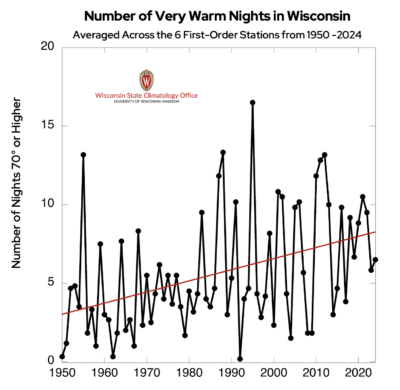
While this change may not feel extreme in the traditional sense, it has significant repercussions. For those without air conditioning, continued heat stress at night can take a toll on their health.
Cattle begin to experience heat stress at temperatures of 70 degrees. Prolonged heat stress can reduce milk production by 30 percent and could lead to lower production of future generations of cattle. Plant growth is also affected as plants become stressed in the continued heat, often resulting in lower crop yields.
This trend in warming nights is likely caused by the greater amount of moisture in the atmosphere in our warming climate. Since water is a good insulator, humid air retains heat better than drier air (think of how a lake stays warm in the fall even as air temperatures get cooler). Because of that, nighttime temperatures usually don’t fall as much when it’s humid.
Where Do We Go From Here?
As our climate continues to warm, extreme weather is projected to become more common. Emergency managers, city planners, and engineers will need to reevaluate their practices, and residents will need to adjust to a new normal for Wisconsin.
To learn more about how these changes are impacting different Wisconsin sectors, browse the Wisconsin Initiative on Climate Change Impacts (WICCI) working groups tab.
For guidance on adapting to these changes and strengthening our communities, check out the latest WICCI Assessment Report.
This is a product of the Wisconsin State Climatology Office. For questions and comments, please contact us by email (stclim@aos.wisc.edu) or phone (608-263-2374).