If you’ve lived in Wisconsin for a while, you’ve likely noticed shifts in the state’s weather and seasons in recent decades. Rain has become more frequent during the winter, 80-degree temperatures linger longer into the fall season, and flooding is more common in the spring.
These changes are a result of Wisconsin’s climate becoming warmer and wetter over time.
Where is the data coming from?
Before diving into these trends, let’s clarify where the data are from and the timeframe that was chosen.
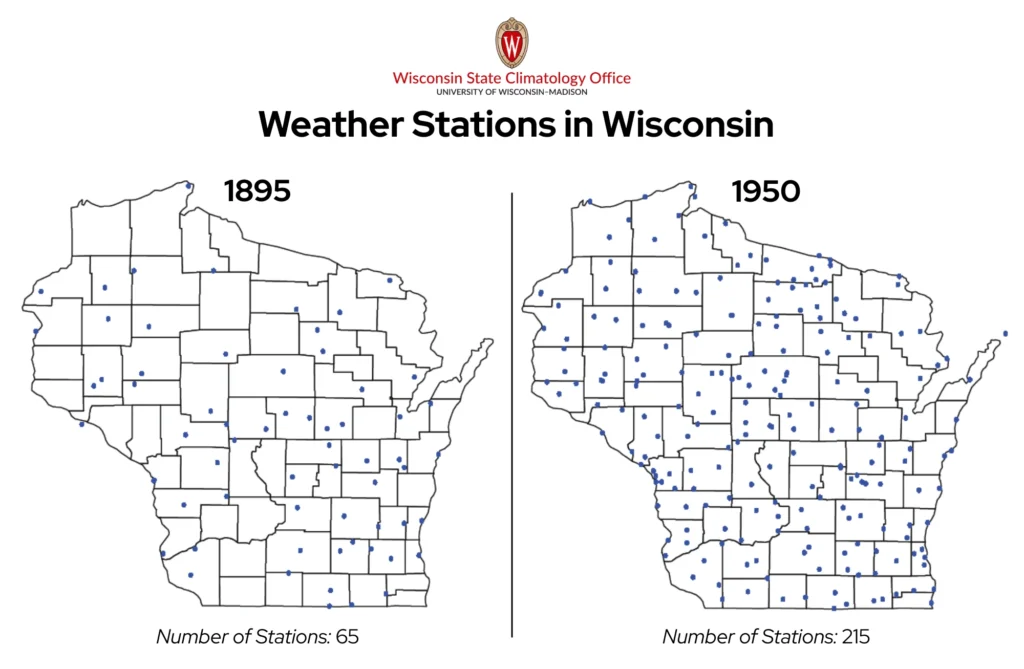
Reliable, consistent documentation of Wisconsin’s weather began in 1895. These records often came from dedicated weather observers along with the National Weather Service. As more observers volunteered, airports were built, and the Weather Service expanded, the observation network grew.
Many climate trends use 1950 as a starting point, as that’s considered a time when enough weather observations were being taken to accurately illustrate the climate of a place. Though older records are available, fewer weather observations at that time produced a limited amount of data. This smaller dataset could paint a general picture of the state, but wouldn’t accurately represent conditions on a county level.
Getting Warmer
Since 1950, the annual average temperature has increased by three to four degrees Fahrenheit across the state.
This may not seem like a significant change when we’re used to temperatures changing by 20 degrees in a given day. Instead, think of our state’s climate as you would your own body temperature.
An adult’s body temperature is typically around 98 degrees Fahrenheit, but a temperature of 100 degrees is considered a low-grade fever. Add just three more degrees to reach a high fever.
Our state (and global) climate is delicately balanced, and a small change can throw it out of whack.
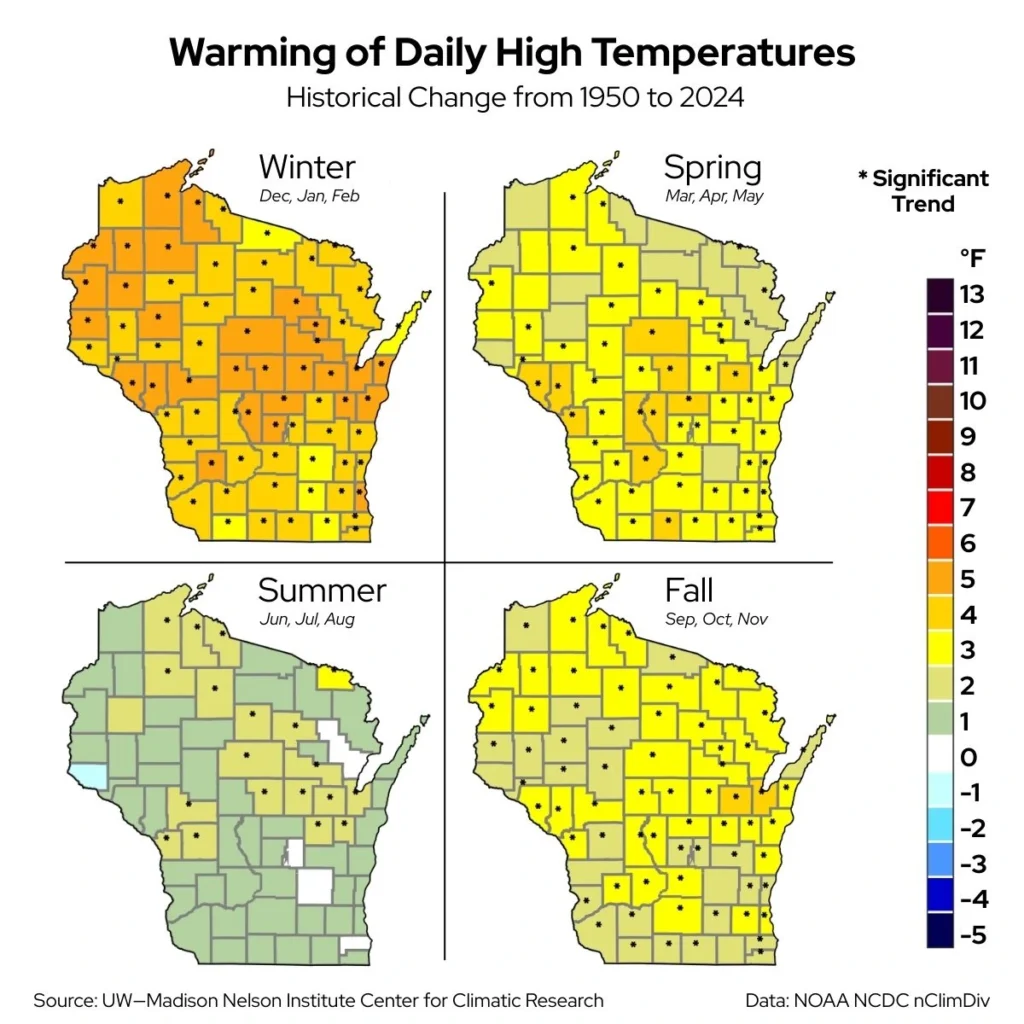
Wisconsin is experiencing warmer temperatures across all seasons, at all times of day, but the warming is occurring at different rates.
Daytime Warming
Average daytime high temperatures have increased most significantly during the winter season, with many counties warmer by 5 degrees compared to 1950. Both spring and fall have seen similar trends in daytime warming, while summer has seen the smallest amount of change.
Nighttime Warming
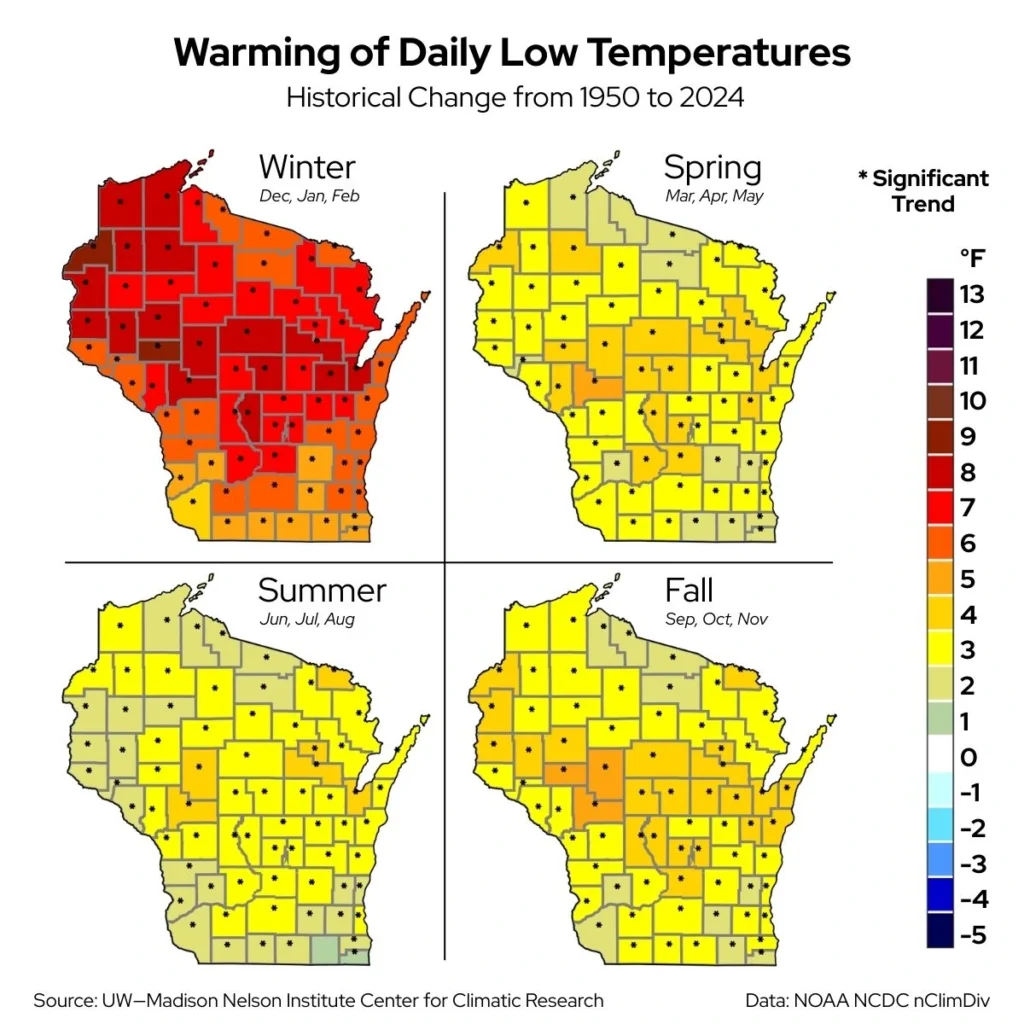
Nighttime temperatures, however, have seen a more significant change in recent decades. Across all seasons, most counties have seen average daily low temperatures grow three to four degrees warmer since 1950.
Low temperatures are warming even more significantly during the winter months, at a rate of one degree per decade on average in many counties.
The number of hours below freezing in Wisconsin has decreased significantly since 1950; so much so that March has essentially shifted from a winter month to a spring month in Wisconsin.
You may have noticed these temperature changes in more subtle ways.
Wisconsin now frequently sees temperatures above 75 degrees lasting a week or two longer into the fall season than usual. As a whole, the growing season has lengthened by an average of 18 days across the state since 1971.
Ice coverage on lakes has shrunk in recent winters, and the Great Lakes reached an all-time low in 2023-24.
Spring thaw has begun to arrive sooner, melting the snowpack and allowing leaves to emerge sooner than usual.
Getting Wetter
The warming of Wisconsin’s climate is closely tied to its increasing wetness. Warmer air can hold more moisture than cooler air. Think of putting wet clothes in the dryer — you likely use the warm cycle, as the warm air will absorb the moisture of the clothes faster than the cool cycle. As our atmosphere grows warmer, its capability to hold more water also grows.
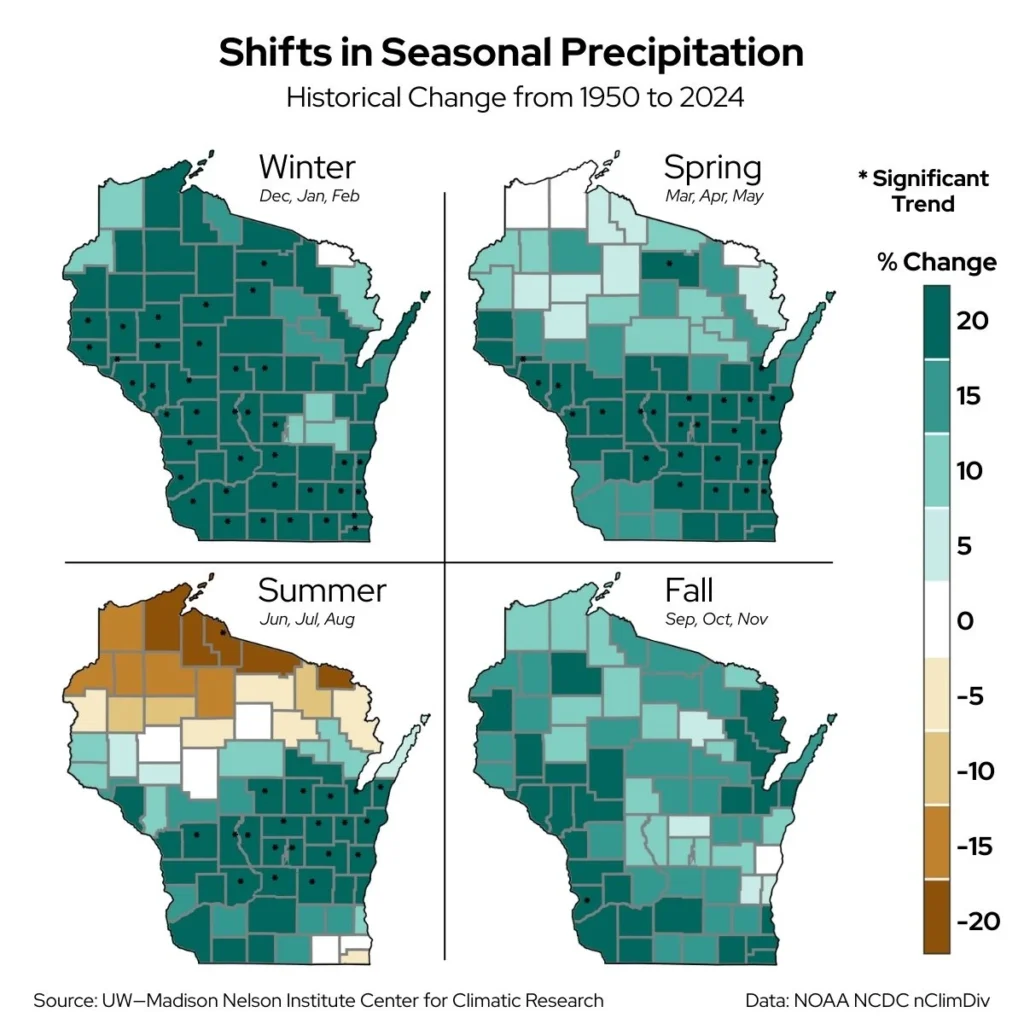
Different regions of the Badger State have seen varying shifts in precipitation from season to season.
The winter season has changed most significantly, with most counties becoming 20 percent wetter on average since 1950. Central and southern Wisconsin have seen similar increases during the spring.
Northern Wisconsin has actually become drier during the summer months, with a 15 to 20 percent reduction in precipitation since 1950. Projections show that summer drying will likely spread across the state in the coming decades.
You may have noticed these changes in precipitation during very wet stretches of weather. The 2010s were Wisconsin’s wettest decade on record, with 2019 ranking as the state’s wettest year. As our climate becomes wetter, farmers struggle to plant in waterlogged fields, pests thrive, and waterfront communities are threatened by rising rivers and lakes.
Added moisture in the air has also made Wisconsin more humid, especially during the summer months. Four of the state’s five most humid summers have occurred since 2010.
Where Do We Go From Here?
The Wisconsin State Climatology Office collaborated with the Nelson Institute for Environmental Studies to create the Analog Climate Explorer tool. This tool gives perspective to the Badger State’s temperatures and precipitation by identifying a location in the U.S. whose climate most closely resembles the conditions recently experienced in a Wisconsin county.
To learn more about how these changes are impacting different Wisconsin sectors, browse the Wisconsin Initiative on Climate Change Impacts (WICCI) working groups tab.
For guidance on adapting to these changes and strengthening our communities, check out the latest WICCI Assessment Report.
This is a product of the Wisconsin State Climatology Office. For questions and comments, please contact us by email (stclim@aos.wisc.edu) or phone (608-263-2374).