County Overview
Juneau County is located in central Wisconsin. The county is in the part of Wisconsin known as the Driftless Region, which is known for its steep, rugged topography since it was untouched by glaciers that covered most of Wisconsin during the last ice age. The land cover of southern Juneau County is primarily a mix of forests, agricultural lands, and grasslands/pasture, while northern Juneau County has a large area covered by wetlands and open water. Two large freshwater lakes, Petenwell and Castle Rock Lakes, are along the eastern border of the county. Juneau County has a humid continental climate, characterized by precipitation year-round and summers that are warm to hot.
Climate Averages
| Season | High Temperature | Low Temperature | Precipitation | Snowfall* |
|---|---|---|---|---|
| Winter | 29.4°F | 11.1°F | 4.0″ | 30.2″ |
| Spring | 54.6°F | 33.2°F | 9.9″ | 9.0″ |
| Summer | 80.3°F | 57.0°F | 13.7″ | — |
| Fall | 59.0°F | 37.3°F | 7.8″ | 2.1″ |
| Annual | 56.2°F | 34.7°F | 35.3″ | 41.4″ |
Averages for all variables in this table are computed for the most recent 30 years (1995-2024; Source: NCEI Climate at a Glance).
*Snowfall averages are computed by averaging station-level data, as NCEI does not provide county-level snowfall averages (Source: ACIS).
Seasons: Winter (Dec-Feb); Spring (Mar-May); Summer (Jun-Aug); Fall (Sep-Nov)
Climate Records
Hottest Recorded Temperature
110°F
(Meadow Valley, July 14, 1936)
Coldest Recorded Temperature
-48°F
(Meadow Valley, February 19, 1929)
Record 1-Day Rainfall
8.14″
(Mauston, August 28, 2018)
Record 1-Day Snowfall
16.0″
(Necedah, December 1, 1985)
Records are computed using all available station data, some of which goes back to 1895 (Source: ACIS).
First & Last Freeze Dates
Average Last Hard Freeze
(28°F)
April 20
Average Last Freeze
(32°F)
May 4
Average First Freeze
(32°F)
October 5
Average First Hard Freeze
(28°F)
October 15
Averages for freeze dates are computed for the most recent 30 years (1995-2024; Source: ACIS).
Temperature
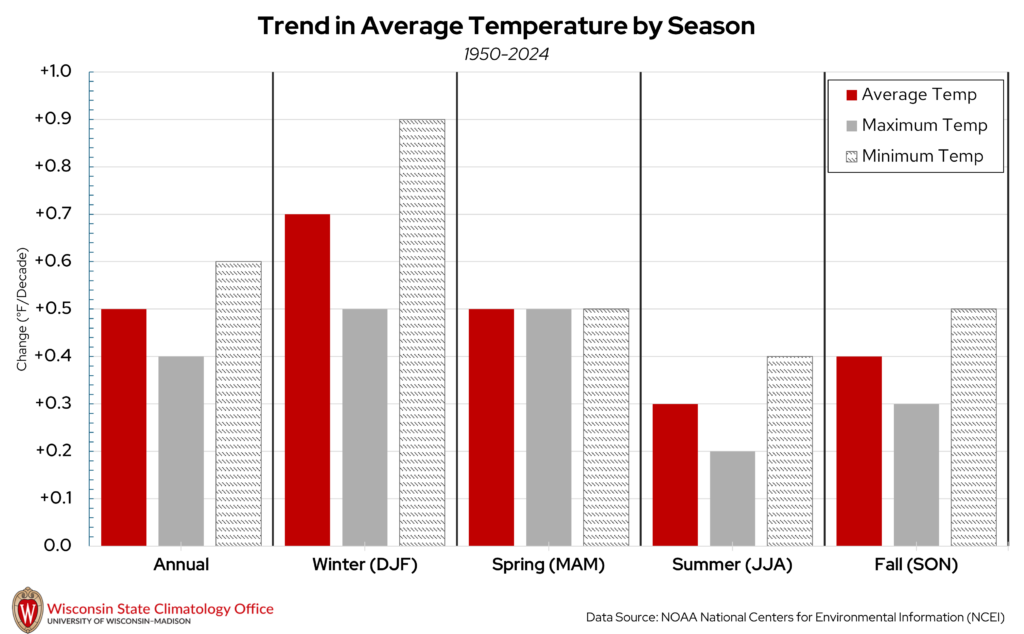
Temperatures have been increasing since 1950 in Juneau County on the annual and seasonal time scales, which is the case for most of Wisconsin. Since 1950, annual average temperatures in Juneau County have increased at a rate of 0.5°F/decade, which translates to an increase of 1°F every 20 years. This increase in temperature has been most pronounced in the winter months and less pronounced in the summer months. When average temperatures are split into daily high and low temperatures, low temperatures have been warming at a faster rate compared to high temperatures.
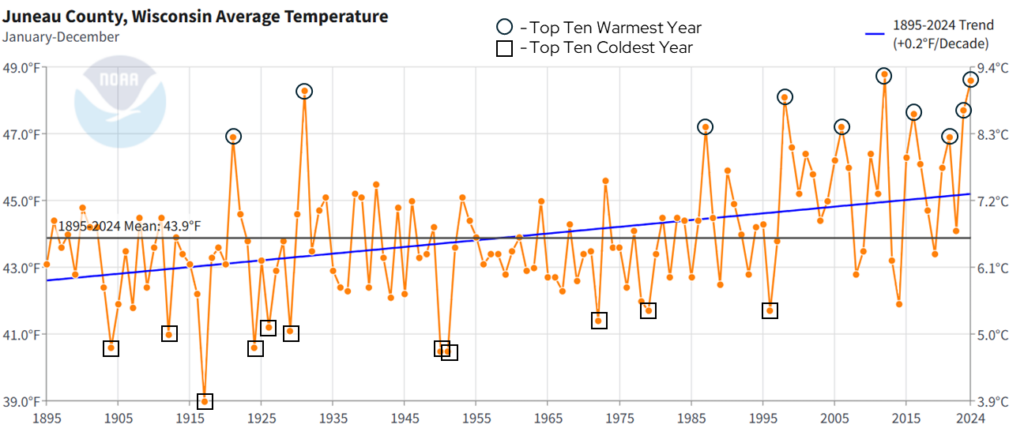
With temperatures warming, this does not mean that every year will be warmer than the last, or that more recent years will all have above-average (1895-2024) temperatures. However, Juneau County is experiencing more years that are above average than it did in the past. For example, since 2000, Juneau County has experienced only five years with below-average temperatures. Similarly, if we rank the top ten warmest years in Juneau County since 1895 (black circles on the above chart), six have occurred since 2000, with 1998 also in the top ten. The top ten coldest years (black squares) are a bit more spread out over time, with all of of the top ten years occurring before 2000.
Precipitation
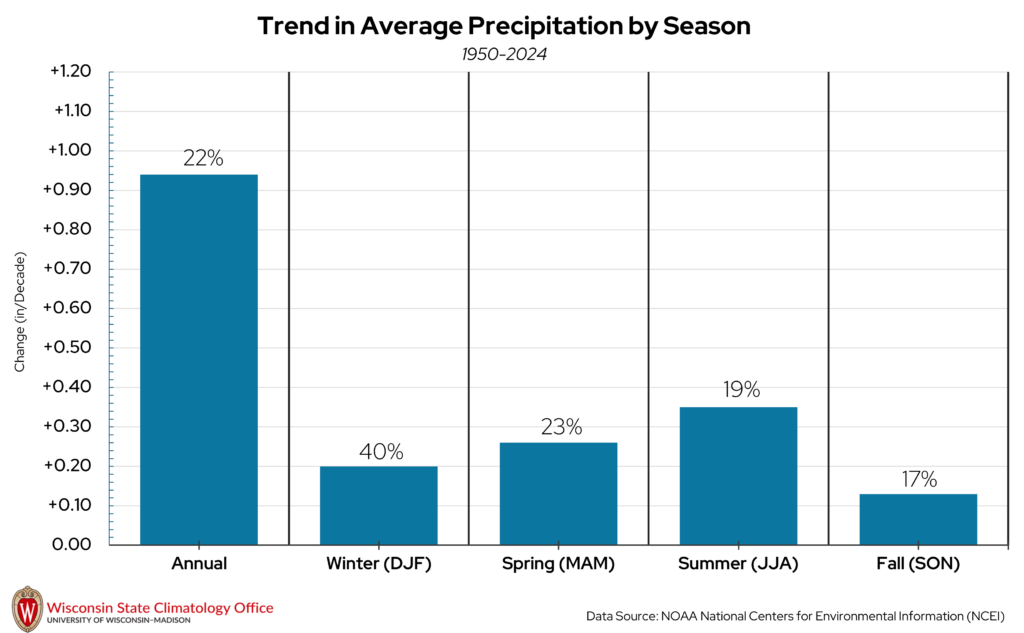
On the annual timescale, precipitation has been increasing at a rate of 0.94″ per decade since 1950. At the seasonal level, precipitation has been increasing across all seasons. Summer is the season of largest increase in precipitation in terms of inches per decade (0.35”/decade), but winter is the season with the largest percentage increase from average annual precipitation in the early 1950’s (40%).
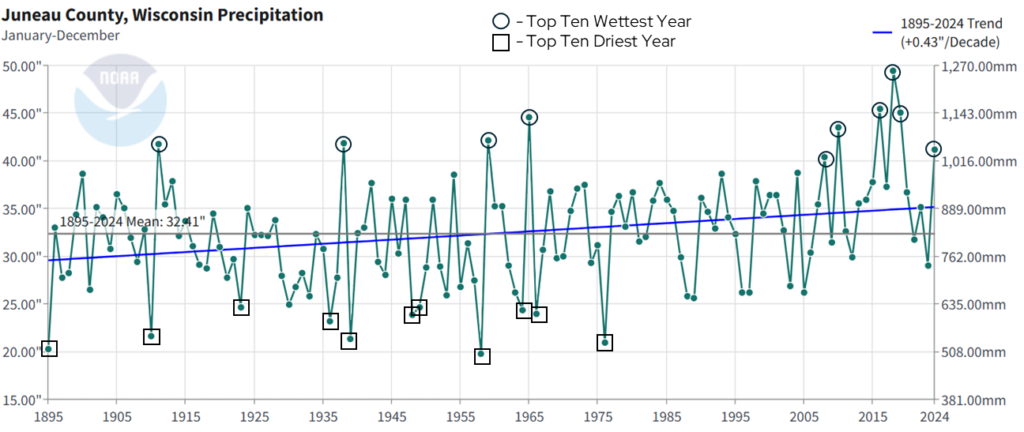
Annual precipitation shows a lot of year-to-year variability, which is normal within a long-term trend. However, there are two notable trends that come from this dataset. First, precipitation is increasing at a rate of 0.43 inches per decade from 1895 to 2024. That’s an increase of one inch approximately every 23 years. Second, if we look at the top ten wettest years since 1895 (black circles), six have occurred within in the past 20 years. By contrast, of the top ten driest years (black squares), all occurred prior to 2000. These trends are quite similar to what has been observed in Juneau County with temperatures since 1895.
Extreme Heat
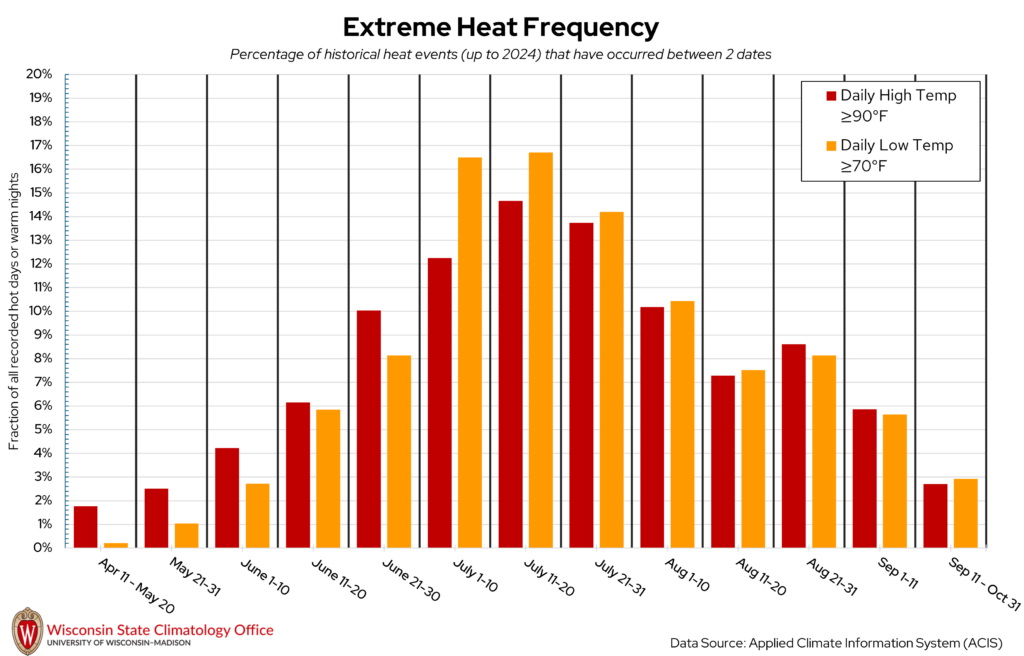
Juneau County is no stranger to sweltering summer heat, where daytime temperatures can top 90°F or even 100°F. But when are these hot days most likely to occur in Juneau County? The State Climatology Office analyzed the likelihood of a “hot day” (daily high temperature ≥ 90°F) or “warm night” (daily low temperature ≥ 70°F) occurring between two calendar dates using historical measured temperature data from NOAA stations in Juneau County. Based on this analysis, hot days have occurred most frequently between July 11 to 20. Warm nights have been most common from July 1 to 20. Over the past 20 years (2005-2024), Juneau County experienced, on average, 12 hot days per year and five warm nights per year.
Have Juneau County summers been getting hotter? Since 1950, summertime average temperatures have warmed by about 2°F, but have not warmed as much compared to other seasons in Juneau County. Summertime low temperatures have warmed by about 3°F since 1950. By comparison, summer high temperatures in Juneau County have not warmed as much (1-2°F). You can read more about trends in summertime temperatures in Wisconsin in this blog post.
Extreme Cold
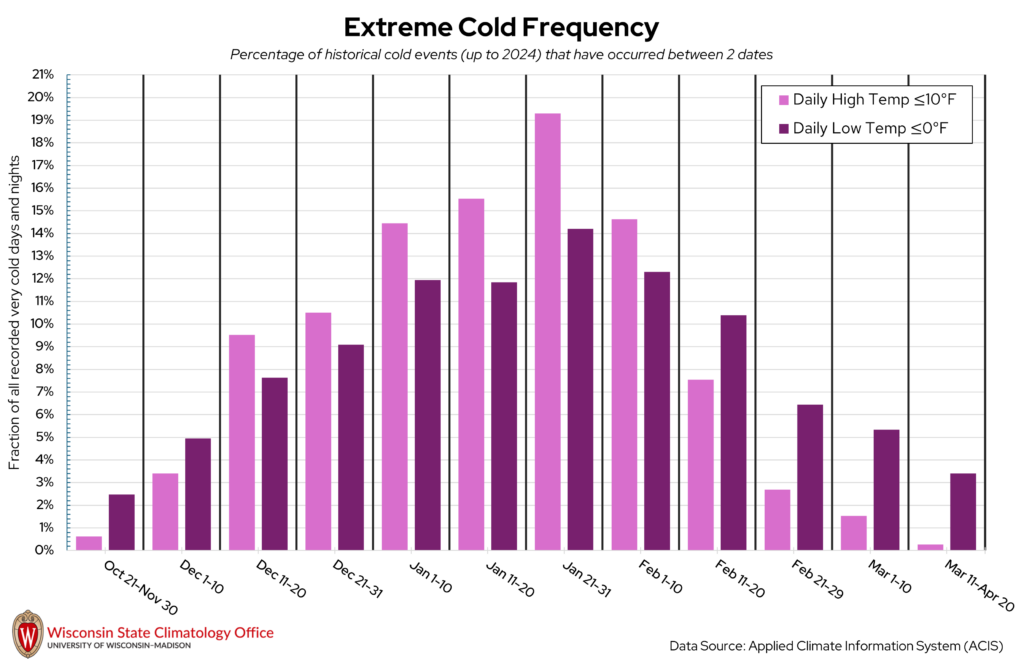
Juneau County can get quite chilly once winter rolls around! Some of our coldest days of the year in Wisconsin are when the overnight low temperatures dip below 0°F. The State Climatology Office performed an analysis on the likelihood of a “very cold day” (daily high temperature ≤ 10°F) or “very cold night” (daily low temperature ≤ 0°F) occurring between two calendar dates using historical measured temperature data from NOAA stations in Juneau County. Based on this analysis, very cold days and nights have occurred most frequently between January 21 to 31. Over the past 20 years (2005-2024), Juneau County experienced, on average, nine very cold days per year and 29 very cold nights per year.
Across all four seasons, winter has warmed the most in Juneau County since 1950, a trend that holds true across most of Wisconsin. Since 1950, average winter temperatures in Juneau County have warmed by 5-6°F. Over this same time period, low temperatures in winter have warmed a bit more than the average temperatures (6-7°F). The coldest temperature of the year in Juneau County has shown a warming trend since 1950.
Precipitation Extremes
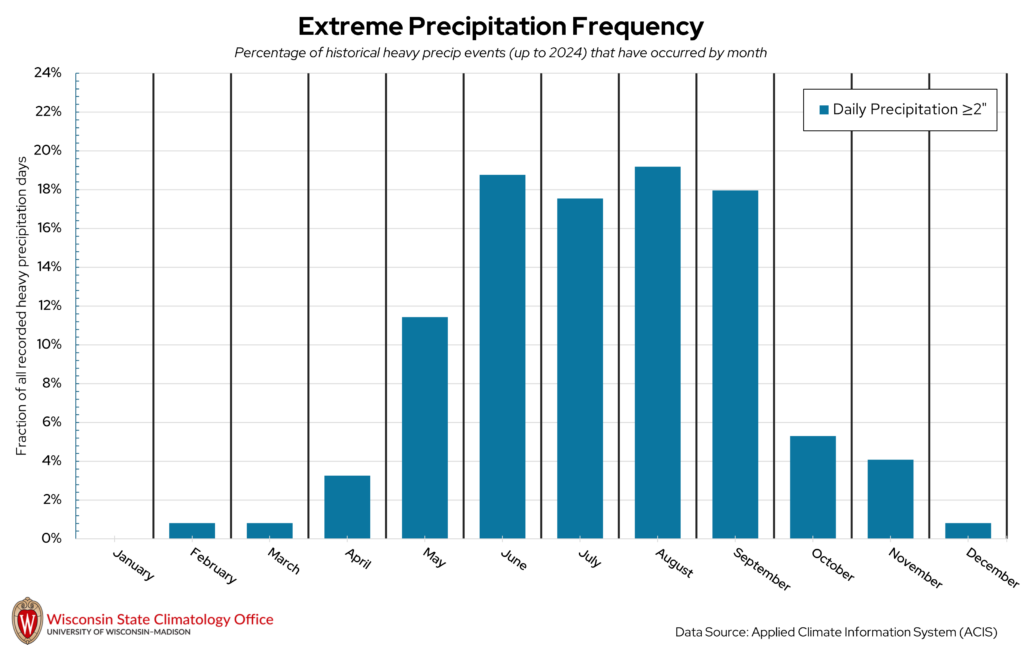
Heavy precipitation days, which for this publication refers to a one-day liquid precipitation total of two inches or more, can impact Juneau County at all times of the year. Extreme precipitation in the winter is measured by the amount of liquid that would be present if you melted down all of the snow that fell that day. The vast majority of these heavy precipitation days (74 percent) have occurred from June through September. August is the month that has historically had the most heavy precipitation days in Juneau County. In general, summer is the wettest season in Juneau County, with winter being the driest season. Over the past 20 years (2005-2024), Juneau County experienced, on average, 13 heavy precipitation days per decade.
Hazards Summary
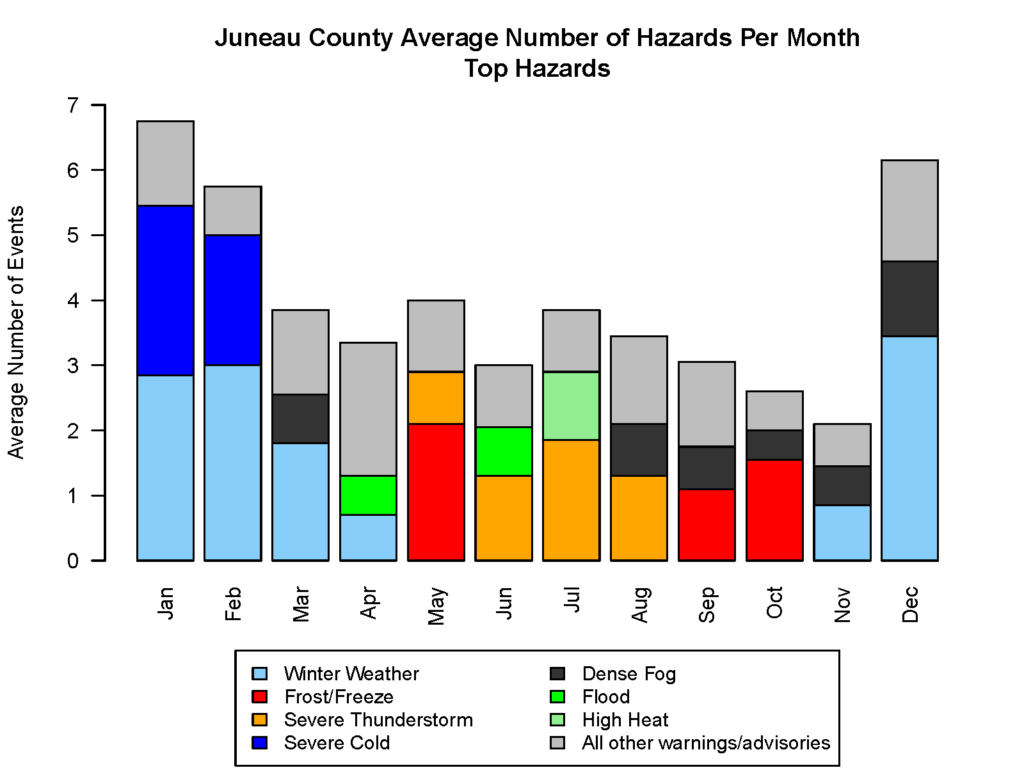
Juneau County deals with an array of hazardous weather throughout the year, and the type of hazards vary from season to season. The bar chart and table above are summaries of warnings and advisories issued by the National Weather Service for Juneau County over the past 21 years (2005-2025). Looking at hazards by month/season, the winter months are characterized by severe cold, snow events, and dense fog. Severe thunderstorms and flooding are more common in the late spring into summer when thunderstorms and heavy rain are more common. Frost advisories and freeze warnings are most common in May, September, and October as these are the times of year when we are transitioning into or out of the growing season and plants are susceptible to frost. Overall, the most common hazards in a year in Juneau County are winter weather, severe thunderstorms, and dense fog. Tornadoes are more uncommon, with one tornado warning issued per every two years for the county, on average.
Hazard Type |
On average, how many does Juneau County have each year? |
| Winter Weather | 13 |
| Severe Thunderstorm | 6 |
| Dense Fog | 6 |
| Severe Cold | 5 |
| Frost/Freeze | 5 |
| Flood | 5 |
| High Wind | 3 |
| High Heat | 2 |
| Ice Accumulation | 1 |
| Tornado Warning | 0.7 |
| Fire Weather | 0.7 |
Looking Ahead
Future climate projections from the Wisconsin Initiative on Climate Change Impacts (WICCI) indicate that by mid-century (2041-2060) under a moderate greenhouse gas emissions scenario, average annual temperatures in Juneau County will continue to increase by approximately 4°F compared to recent averages. Winter is projected to continue to be the season of the largest temperature increase (about 5°F). The number of nights where temperatures drop below 0°F is expected to decrease as winters warm (10-15 per year), and the number of nights in summer with temperatures staying above 70°F is expected to increase. The frequency of days that top 90°F are projected to increase with a warming climate (30-35 days per year). Days that top 100°F have been relatively rare in Juneau County up to 2025, but WICCI projections indicate that temperatures will hit 100°F a few days per year by mid-century.
Annual precipitation is expected to increase by around five percent by mid-century, according to WICCI projections. Winter and spring are projected to be the seasons of greatest precipitation increase in Juneau County (about 10%), with summers projected to be 5% drier by mid-century. Despite projections for drier summers, the frequency of heavy precipitation days (two inches or more) is projected to increase by mid-century.
To explore more climate projections from WICCI and learn more about future climate modeling, please visit this website.
Want more information?
The data in this publication are a snapshot of the historical climate data for Juneau County. If you have questions about this publication or would like more data on a topic, please contact the Wisconsin State Climatology Office.
For more information about how climate affects your farm, community, health, and livelihood, please check out these resources from the Division of Extension and the Wisconsin Initiative on Climate Change Impacts.