Though Wisconsin is known as America’s Dairyland, some corners of the state boast their ranking in a different industry: maple syrup production. Over the years, Wisconsin has ranked fourth in the country in maple syrup production, behind Vermont, New York, and Maine.
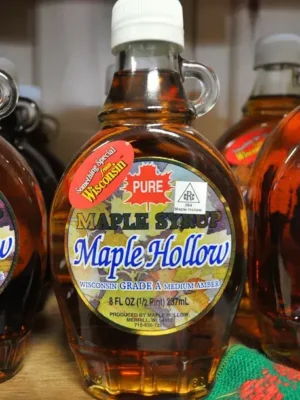
However, during the last decade, production of maple syrup across the state has increased due to improved technology and more taps. Even with less than one percent of Wisconsin’s available maple trees being tapped, the state produced an estimated 556,000 gallons of maple syrup in 2025.
With this, Wisconsin has now surpassed Maine to become the country’s third-largest syrup-producing state. The state’s crop is currently valued at approximately $15 million per year.
History of Maple Syrup in Wisconsin
For centuries before Europeans settled in areas that are now Wisconsin, Native Americans made sugar for sweeteners and flavorings from the sap of maple trees using a similar multi-step process that’s used today. Some of the tribes, such as the Menominee, the Ho-Chunk (Winnebago), the Ojibwe (Chippewa), and the Potawatomi, considered maple trees in a cultural and spiritual sense as they mastered the art of tapping, boiling, and sugar production.
Typically, families established camps among groves of sugar maples and collected sap seeping from cuts on the tree trunks. By the time Wisconsin reached statehood in 1848, European settlers had adopted many of the indigenous tribes’ sap-collecting techniques.
Until 1890, maple sugar was cheaper than imported cane sugar, so it remained popular. As sugar cane prices fell, maple sap collectors shifted production to maple syrup.
Why the Sugar Maple?
The sap tapped from maple trees in spring consists of water, stored starches, and mineral nutrients from the soil. These absorbed minerals affect the sap’s chemical composition, thereby impacting the syrup’s flavor.
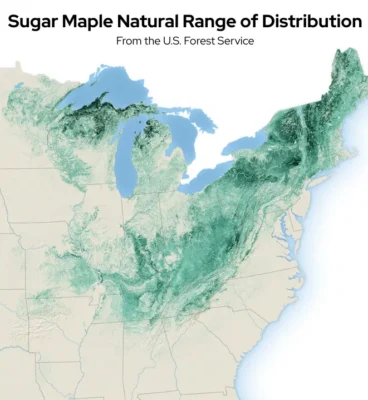
Sap from sugar maples has the highest natural sugar content among maple species. Other tree species could be tapped for syrup, but their lower sugar content and slower sap flow would make the process more involved.
In Wisconsin, sugar maples dominate the northern forests, but can still be found in smaller concentrations in the south. Due to its prominence across the state, the sugar maple is Wisconsin’s official state tree.
Most of Wisconsin’s maple syrup producers are found across the central part of the state, from Pierce to Langlade counties. Shawano, Manitowoc, and Sheboygan counties typically produce the most syrup in the state.
Weather’s Effect on Sap Flow
Wisconsin’s sugaring season usually runs from late March to early April, as the flower buds begin to swell but before these buds reach full bloom.
The trees use stored energy from the starches produced during the previous year to fuel this early-season growth. When the tree’s outer layer of trunk reaches about 40 degrees during a warm period, enzymes transform these starches into sugars that are then released into the sap.
Optimal weather conditions for sap collection are consistent sunny days with daytime temperatures of at least 40 degrees, paired with cool nights with temperatures of around 25 degrees.
This daily freeze-thaw cycle creates changes in pressure inside the tree. Above-freezing temperatures put positive pressure on the tree, which pushes sap down through the tree and out through tap holes. When temperatures drop below freezing at night, negative pressure in the tree draws sap back up through the roots and into the trunk.
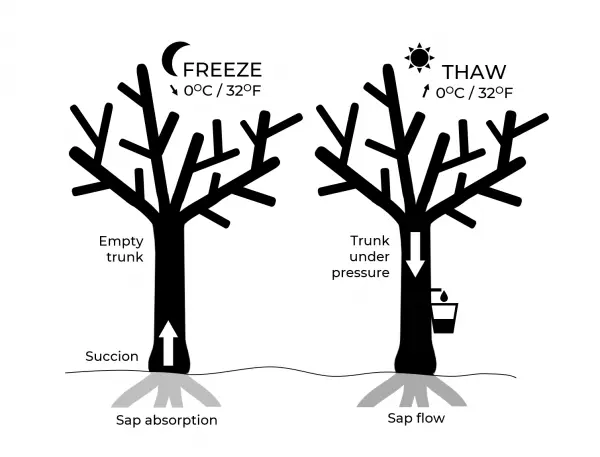
On average, maple trees can produce one to three gallons of sap per day during the sugaring season. However, production can vary day-to-day or year-to-year, as flow is sensitive to weather changes. Once the tree buds begin to turn into leaves, the sugaring season is over.
Before Tapping Season
The weather leading up to tapping season can determine how successful the season will be.
Long periods of subfreezing temperatures during winter and spring can reduce sap flow. In 2014, unusually cold weather persisted into spring following the state’s fourth coldest winter on record. Soil frost had penetrated deeper into the ground than usual, which delayed sap flow. During that year, Wisconsin produced about 100,000 fewer gallons of syrup than usual.
Conversely, warm weather can also diminish or stop sap flow, as buds break open early in response to the warmth. Once a tree’s buds open, they begin to use sugar from the tree’s sap. This lowers the sugar content in the sap that’s to be tapped.
The weather of March 2012 was one of the worst in decades for Wisconsin’s maple syrup industry, as the state’s warmest March on record cut the sugaring season to less than ten days.
A lack of moisture in the soil can also affect tree sap flow. Consistent snow cover through the winter protects a sugar maple’s shallow roots from freeze damage and maintains moisture in the soil. If conditions are too dry during the previous summer or fall, a tree will have less energy to produce starches, causing lower sap sugar content the following spring.
Predicting Sap Flow
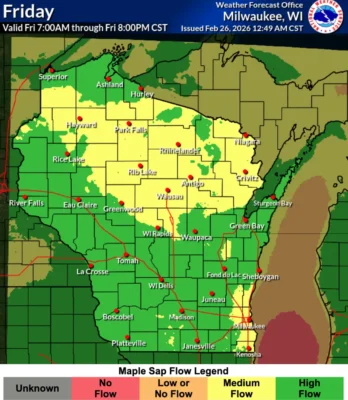
The Wisconsin State Climatology Office and the University of Wisconsin—Madison Division of Extension partnered with the National Weather Service to develop an experimental Wisconsin Maple Sap Decision Support Services Page.
These maps are intended to help state maple producers track optimal sap flow conditions during the spring. Conditions are projected using forecasts of daytime maximum temperatures and nighttime minimum temperatures.
Statewide maps are produced twice daily with the most likely amount of sap flow for a day: high (one gallon), medium (one-quarter to one gallon), low (less than one-quarter a gallon), or no flow.
A point-and-click map shows the projected maple sap flow for the following seven days for a select location in Wisconsin.
Turning Sap Into Syrup
In early March, when the tree buds begin to swell, sugar makers drill a small hole into the trunk of the tree. A spout, called a spile, is tapped into the tree and fitted with a cover to keep rain or snow out.
Traditionally, metal buckets were hung on the spile to collect the sap. The buckets were then emptied into larger containers to be transported to the sugar house.
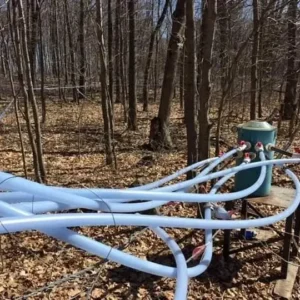
Since the late 1960s, plastic tubing has been used by commercial sugaring operators to cause the sap to run from the spile directly to a collection tank. These networks employ gravity or a vacuum pump to pull sap out of the tree, increasing production.
The sap is delivered to the sugar house, where it is run through an evaporator to remove the excess water. This will allow the syrup to reach the standard maple syrup ratio of about 67 percent sugar and 33 percent water.
Generally, a tap hole yields about 10 gallons of sap, which boils down to about one quart of syrup.
The Future of Wisconsin’s Sugar Bush
Winter temperatures across Wisconsin are expected to continue increasing over the coming decades. These increased winter temperatures would lead to an earlier arrival of spring weather and warmer temperatures. As a result, some species of maple trees could show changes in productivity.
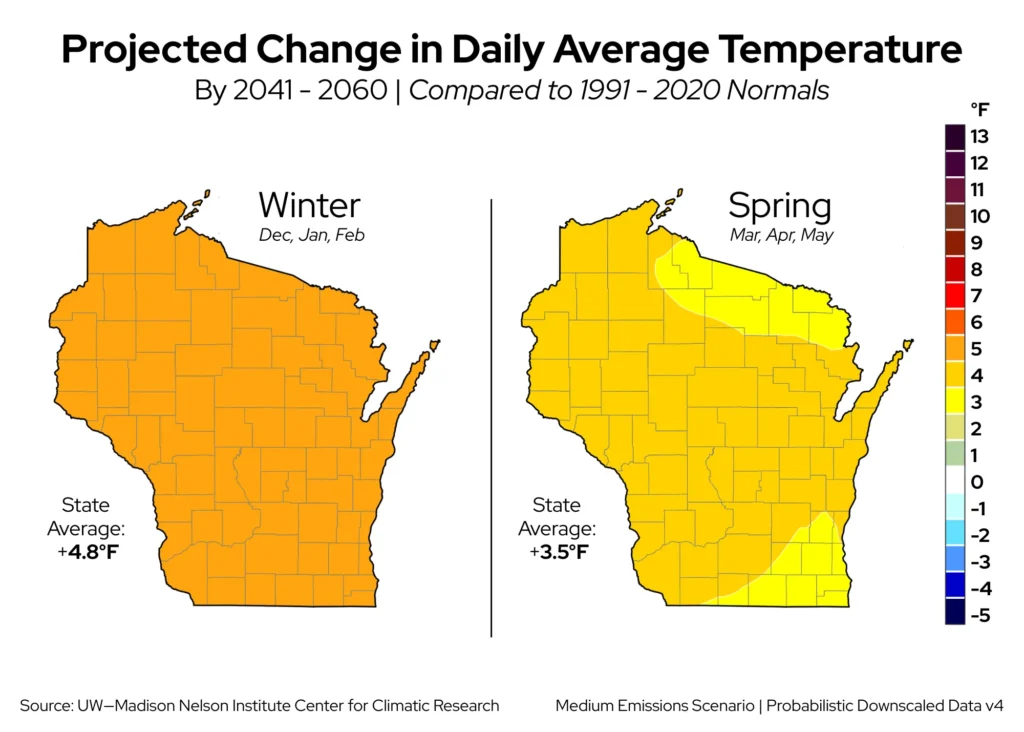
With increased warmth, the days with the ideal freeze-thaw cycles for sapping are expected to decrease and shift earlier in the year. Thus, the prime sugaring season would be earlier and more unpredictable.
Added warmth could also affect the stability of Wisconsin’s winter snow cover, allowing frost to penetrate deeper into the ground. Deeper freezing soils can damage the roots of shallow trees, including sugar maples.
Anticipated warmer summers across the state could impact the trees’ capability to store starches. This would result in lower sugar content in maple tree sap during the spring, possibly by as much as 30 percent.
Since maples germinate at lower temperatures, a northward shift in the species could be seen in the coming decades. Producers may have to move their focus from sugar maples to other species that are more tolerant of warmer conditions.