Things can get quite chilly in the Badger State once winter rolls around! As the temperatures drop below freezing, Wisconsin’s many lakes begin to freeze over. Lake ice is important for winter tourism, local climate, and lake ecology. However, as winters in Wisconsin have shifted in recent decades, the number of days with ice cover on our lakes has also changed.
Why is lake ice important?
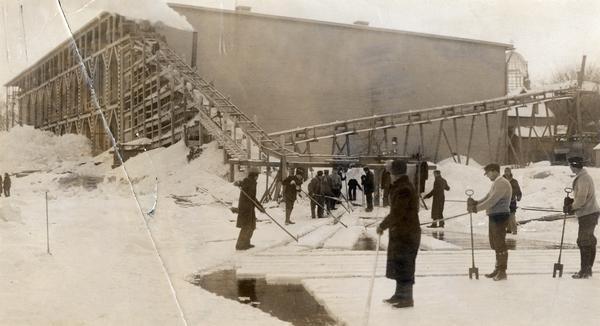
During the late 1800’s, Wisconsin lake ice was highly sought-after by breweries and meatpacking companies in Milwaukee and Chicago. Before modern refrigeration, rail cars were packed with ice to keep meat and beer cool in transport. Wisconsin’s lake ice was highly sought-after because it had, for the most part, a thickness and clarity that made it ideal for shipping to the larger cities. The lake ice trade in Wisconsin continued up until the early 1900s.
In more recent times, lake ice has contributed to Wisconsin’s economy through recreation and tourism revenue. In 2023, boating and fishing (including ice fishing) contributed $928 million to the state’s gross domestic product. And speaking of fishing, lake ice can help protect fish and plankton from harsh winter conditions.
Lake Ice Trends
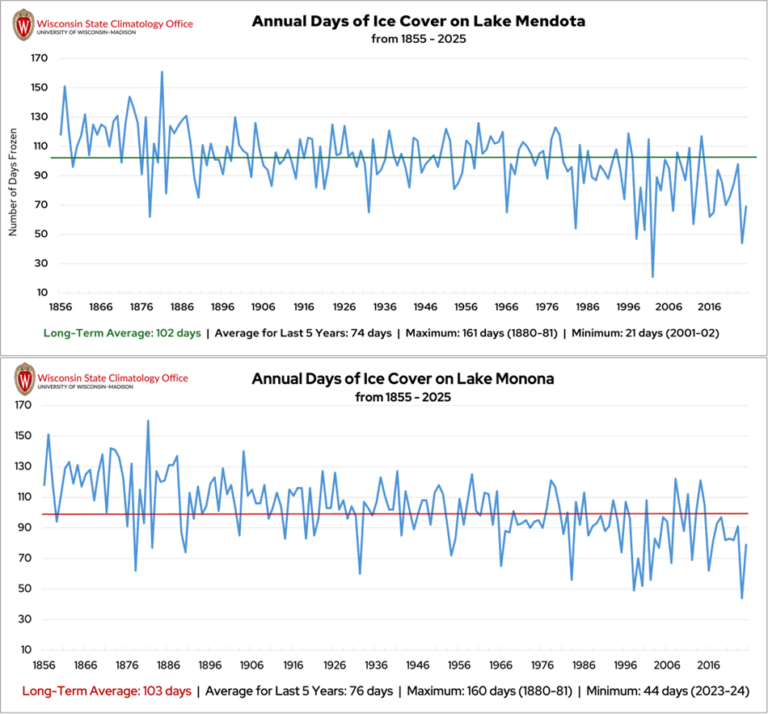
As winters have gotten warmer in Wisconsin, there has been a reduction in lake ice coverage and duration. Recent research finds that as our temperatures are projected to increase in the future, the number of lakes in the northern hemisphere experiencing intermittent ice cover will greatly increase. Long-term data at Lakes Mendota and Monona indicate a declining trend in annual ice cover duration. Likewise, on the Great Lakes, there has been a declining trend in annual lake ice coverage since the 1970s. Longer periods of open water on the Great Lakes can be expected to lead to an increase in lake-effect precipitation.
Impacts of declining lake ice duration
- Shrinking lake ice duration is limiting ice fishing opportunities and creating ripple effects throughout the local economy.
- Fish eggs from species that spawn in winter will be more susceptible to fluctuations in winter weather if there is no ice cover. Also, if fish eggs hatch earlier with spring ice melt trending earlier, there may also be a shortage of plankton available for them to eat since plankton do not reproduce as quickly in colder water.
- Warming water temperatures are detrimental to species that are adapted to cooler temperatures and can lead to increased competition between cold water and warmer water fish species.
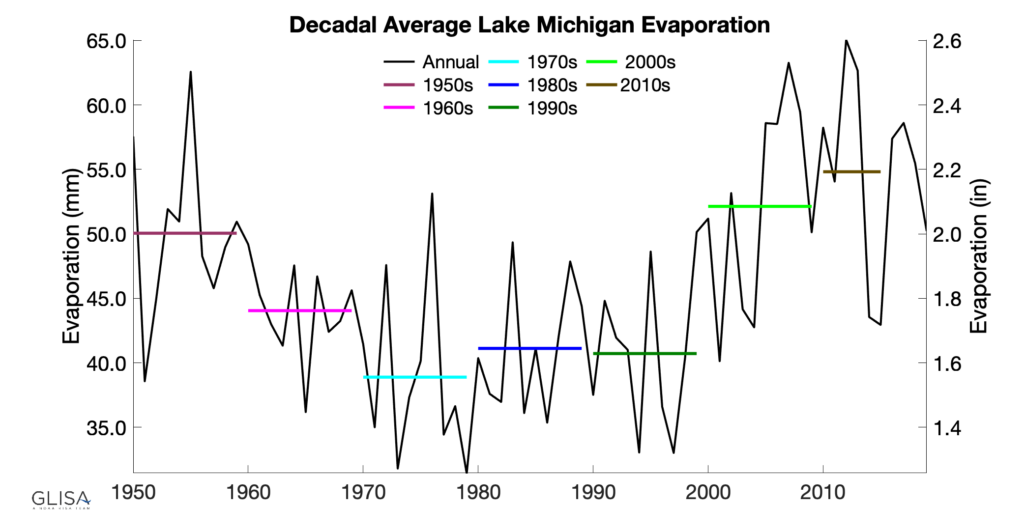
- A shorter duration of ice cover on the Great Lakes leads to increased evaporation of lake water to the atmosphere, which can lead to decreased water levels during drier years.
Being safe on the ice
Falls through the ice on Madison lakes have become more common as winters have warmed. Other Wisconsin cities along lakes have experienced similar trends. It is very important to remember that no thickness of ice is 100 percent safe under your feet. If you plan to venture onto the ice, avoid thin or cracked ice, bring your cellphone with you, and be equipped with gear to get yourself out of the water if you fall through. To learn more, visit this website from the Wisconsin DNR on ice safety.
This is a product of the Wisconsin State Climatology Office. For questions and comments, please contact us by email (stclim@aos.wisc.edu) or phone (608-263-2374).