Ever since the bitterly cold 1967 National Football League championship game in Green Bay, Wisconsin has been nicknamed the “Frozen Tundra.” Though usually not quite as cold as its neighbor state of Minnesota, Wisconsin has recorded its fair share of extreme cold temperatures.
The Coldest Time of Year
Over the last 142 years, nearly half of the Badger State’s coldest temperatures have occurred in January. Slightly less than one-third have occurred in February, with the remainder in December and March.
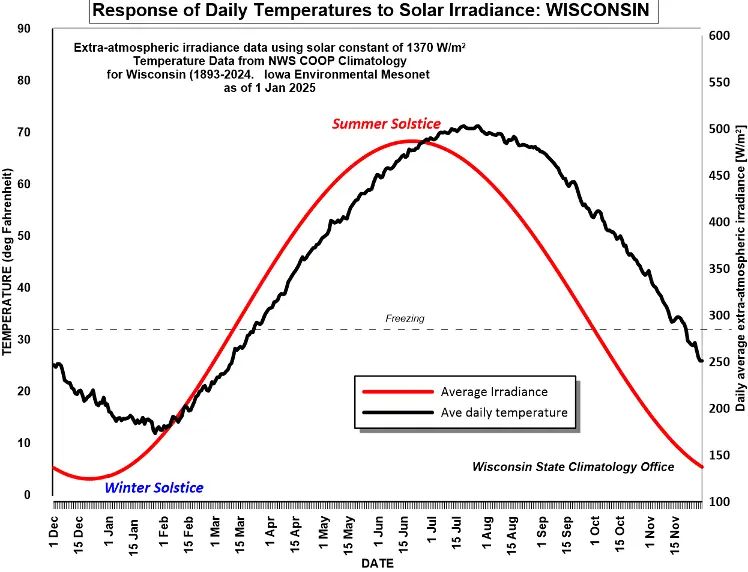
The distribution of Wisconsin’s coldest days follows the pattern that the coldest weather of the season typically occurs four to six weeks after the December winter solstice. Since the winter solstice has the shortest daylight length and the lowest sun angles of the year, you would think that the lower amount of solar energy would result in the coldest conditions.
However, it takes a while for the ground and atmosphere to respond to these changes, like water in a bottle takes time to cool when placed in a refrigerator. This phenomenon is called seasonal lag.
Many of Wisconsin’s coldest conditions are caused by a cold Arctic air mass that drifts southward. The presence of snow cover often aids in cooling the air further, allowing temperatures to plummet.
Some areas of the state can be partially sheltered from the extreme cold by Lakes Superior and Michigan, but only if the lakes have remained relatively free of ice.
Diving Into the Records
The Wisconsin State Climatology Office has been maintaining daily weather records for approximately 267 weather stations in the state since the 1870s. These records have been evaluated by the State Climate Extremes Committee (SCEC) to determine the date and location of the lowest air temperature recorded in the Badger State.
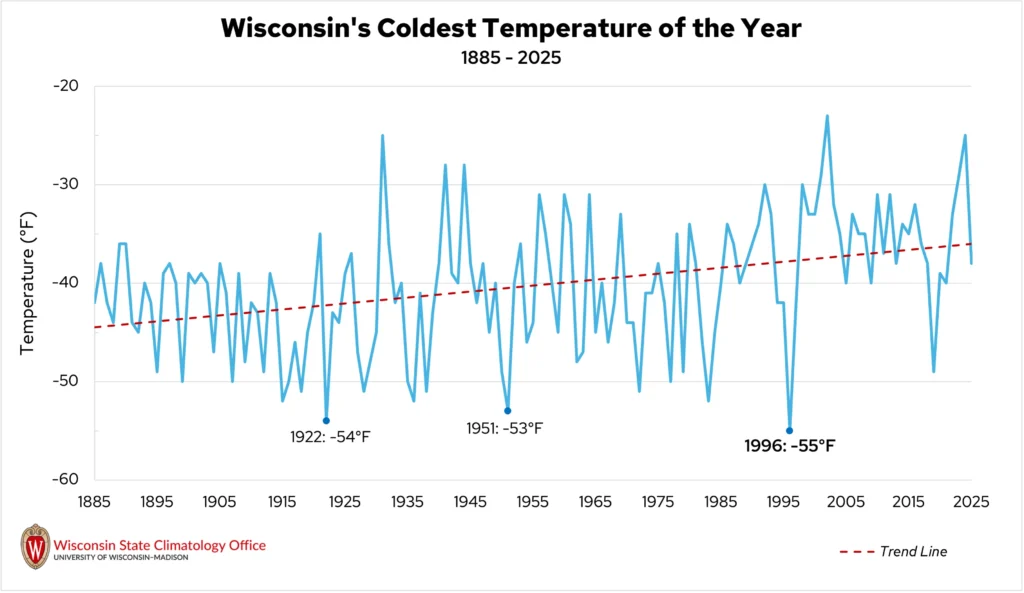
The official coldest temperature that has been recorded in Wisconsin is -55 degrees Fahrenheit. This was measured near Couderay, in Sawyer County, on February 2, 1996. Two days later, the station reached the same temperature again!
You may have heard of an even colder temperature of minus 60 degrees being measured in Rice Lake in Barron County in 1977. Unfortunately for Rice Lake residents, the SCEC found that the equipment used at that location did not meet their standards, so it was not accepted as a record.
Historically, Wisconsin has seen temperatures reach those extremes only on a handful of occasions. Fourteen stations in the state have reported low temperatures of -50 degrees or colder since 1885. Nearly all of these reports came from the northern counties of the state.
Only three stations in the state have reported a temperature of -53 degrees or colder; these three occurrences are seen on the graph and will be described below.
Couderay: February 2, 1996
In early February 1996, an exceptionally cold Arctic air mass spread into the Upper Midwest.
On February 2, the center of this Arctic high-pressure system was over South Dakota. Thanks to the high pressure, skies were mostly clear and winds were light, allowing the atmosphere to cool quickly. In addition, the snow depth in northern Wisconsin at the time was 25 inches, further cooling the air.
The location of the Couderay weather station often allows it to get much cooler than the surrounding areas. The station is situated in a low-lying marshy area that is prone to cold-air drainage.
All of these factors played a role in Couderay reaching the frigid 55 degrees below zero reading on February 2 and 4. In addition to Wisconsin, Minnesota and Iowa also set state record lows during this cold weather event. Within Wisconsin, 34 stations reached their coldest temperatures of all time during the first five days of February.
Danbury: January 24, 1922
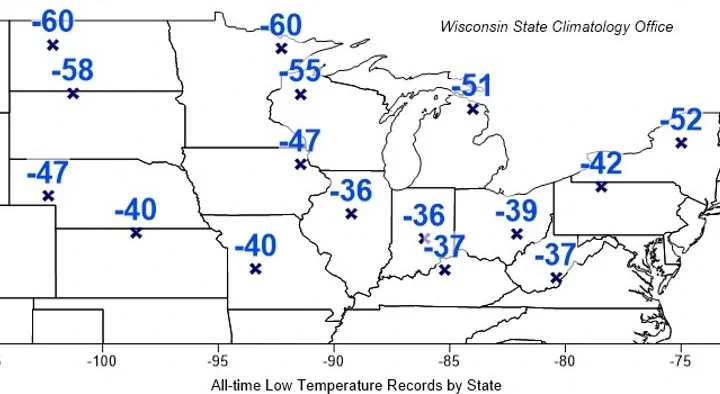
Prior to 1996, Wisconsin’s coldest temperature stood at -54 degrees, recorded in Danbury on January 24, 1922. At the time, this was reported to be the lowest temperature in the nation east of the Mississippi River.
The small Burnett County community of Danbury lies along the St. Croix River. The sandy soils, numerous lakes, and low-lying areas are conducive to cold winter temperatures.
A large Arctic high-pressure system drifted across the Dakotas on January 24. The U.S. Weather Bureau (now called the National Weather Service) had already posted cold wave warnings across southern Wisconsin, as temperatures were expected to plunge quickly.
The weather observer in Danbury reported a high temperature of 25 degrees on January 23, followed by a high of one degree on the 24th.
Lone Rock: January 30, 1951
Another Arctic outbreak spread across the state on January 30, 1951, resulting in a statewide average low temperature of minus 36 degrees. What’s unusual about this event is that the coldest temperature was observed in southern Wisconsin.
The station at the Tri-County Airport in Sauk County outside Lone Rock reported a record low of -53 degrees on January 30, just one degree above the state record at that time.
Some residents have said temperatures were cold enough to break the thermometer at the airport! Paint was even seen peeling away from metal buildings in town. Students got the day off from school, but only because the building’s furnace had gone out.
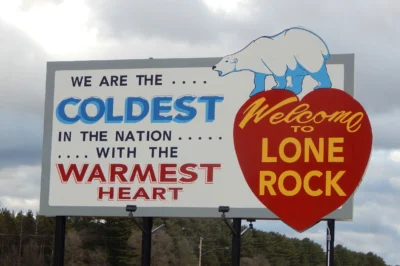
The media reported this temperature as the lowest of any weather station in the lower United States that day. The notoriety led to the construction of a large billboard along Highway 14 that proclaims, “We are the coldest in the nation with the warmest heart.”
The atmospheric setup for the event was very similar to that of the 1922 and 1996 events. An Arctic air mass accompanied by clear skies and light winds allowed temperatures to drop rapidly at night. Plus, the area had a relatively deep snow cover of 19 inches, with six inches having just fallen in the days prior.
The low elevation of the village in the Wisconsin River Valley and the sandy soil of the region also contributed to the near-record-setting cold.
On that same frigid January day, Madison established its record low of 37 degrees below zero at the Madison Municipal Airport Terminal (also known as Truax Field). This temperature remains the lowest of any temperature officially recorded in Madison since records began in 1869. Sixty-one of the 120 reporting stations in Wisconsin also reached their all-time coldest temperature.
Recent Memorable Cold Spells
During the final three days of January 2019, residents of the Upper Mississippi Valley experienced the most extreme cold since February 1996.
This cold spell was noted for the number of hours that the temperature remained below zero and record-low wind chill temperatures. On the morning of January 30, 2019, the Menomonie Municipal Airport in Dunn County measured a wind chill of 60 degrees below zero! The air temperature at the time was 33 degrees below zero with a sustained wind of 13 miles per hour. You can read more about Wisconsin’s record wind chills in this blog.
More recently, Wisconsin experienced an Arctic blast in late January 2026 that caused air temperatures to drop to 40 below zero and wind chills to 50 below. The coldest temperature was -42 degrees in the town of Knight in Iron County, and the coldest wind chill was -56 degrees in Rhinelander, a new record for the city.
How Long Will the Record Stand?
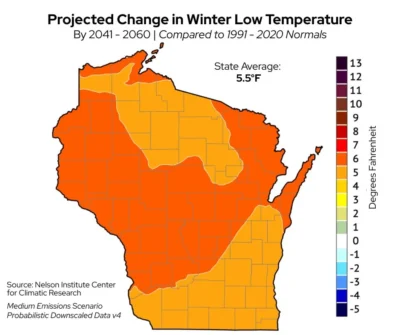
Winters across Wisconsin have been warming over the last 50 years. Winter nighttime low temperatures have been increasing even faster than daytime high temperatures, eliminating some of Wisconsin’s coldest conditions.
These trends are expected to continue over the coming decades. Projections from the Wisconsin Initiative on Climate Change Impacts show that nighttime low temperatures during the winter could warm by five to six degrees across the entire Badger State by midcentury.
However, the global warming trend could lead to Wisconsin experiencing more frequent bursts of Arctic cold. As the atmosphere warms, the polar vortex and polar jet stream tend to weaken and become more unstable. This can allow cold air to sink southward over North America. While these blasts of cold are still headline-worthy in the U.S., the intensity of the cold will likely lessen as Arctic temperatures continue to warm.