Depending on the year, March can feel like a full extra month of winter or more like the beginning of spring. As the seasons change this month, Wisconsinites can be kept on their toes with thunderstorms one day, followed by a snowstorm the next week.
By meteorological standards, March is the start of the spring season. You can read more about what the season might have in store for Wisconsin this year in our spring weather outlook.
Temperature
The Outlook: Trending Warm
NOAA’s Climate Prediction Center is forecasting a chance for warmer-than-average temperatures this month, not only in Wisconsin but across much of the country. Far southern Wisconsin is likely to see above-average temperatures, while chances decrease farther north.
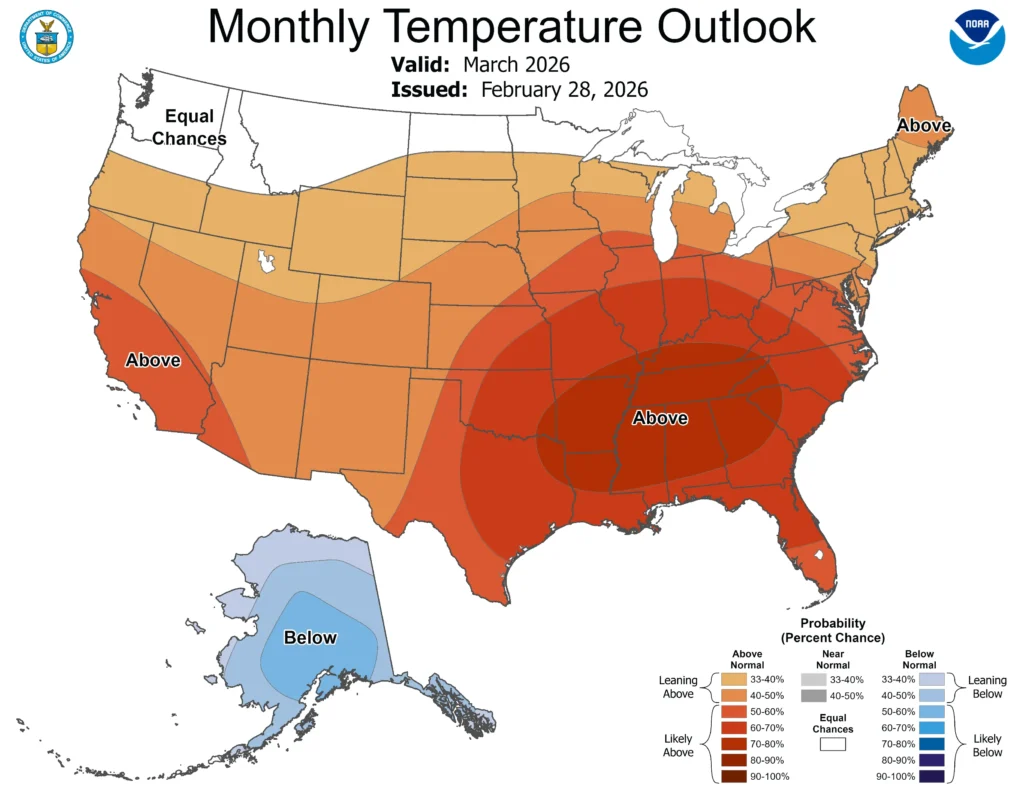
Note that the colors of the above map indicate the probability of above or below average temperatures, not the intensity of the expected warmth or cold. In this case, northern Wisconsin has a 33 to 40 percent chance of experiencing above-average temperatures, while southern Wisconsin has a 50 to 60 percent chance.
Check out this blog for more information on deciphering climate probabilities.
The Averages:
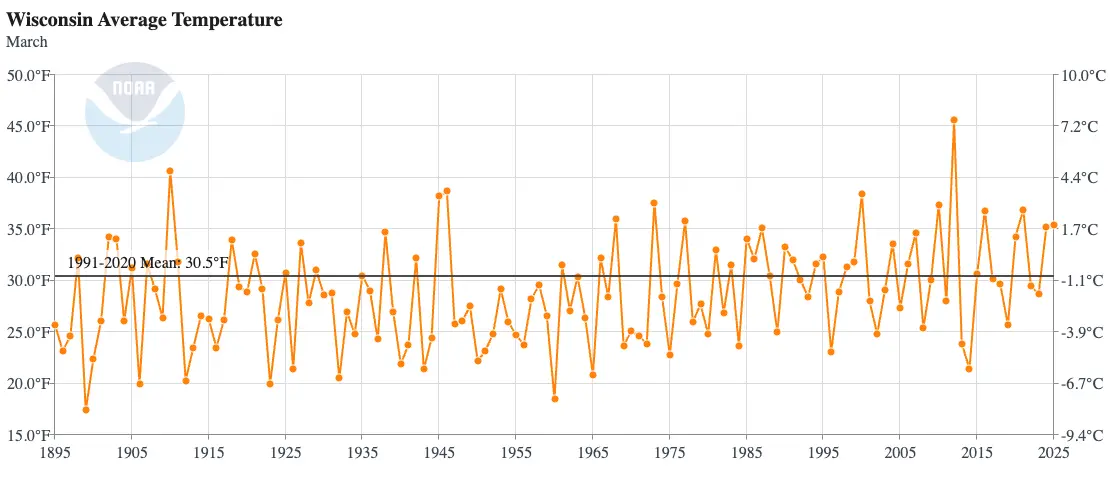
The start of March often feels more winter-like, with daily high temperatures near freezing. By the end of the month, even northern Wisconsin can see highs nearing 50 degrees Fahrenheit. Wisconsin’s statewide average temperature for the month is 30.5 degrees — over 10 degrees warmer than the February average.
Not only do high temperatures heat up throughout the month, but the state also begins to lose its very cold nights. Both Madison and La Crosse typically see the final single-digit temperatures of the season in early March, while Eau Claire, Green Bay, and Wausau see their final by mid-March. Milwaukee often leaves the single digits behind in February.
However, in 1899, single-digit and even sub-zero temperatures lasted through late March! Northern regions of the state experienced temperatures of 10 to 20 degrees below zero during the final week of the month. This was Wisconsin’s coldest March on record, with a statewide average temperature of just 17.4 degrees.
March 2012 almost felt like summer in Wisconsin, with temperatures of 80 degrees even up north. Across the country, a persistent blocking pattern in the atmosphere kept the central and eastern states feeling the heat, while western states were left in the cold. In the Midwest, the unusual warmth led to more than 6,000 daily temperature records being set. Wisconsin’s statewide average temperature was 45.6 degrees, which is 15 degrees warmer than the March average!
Precipitation
The Outlook: No Shortage of Showers
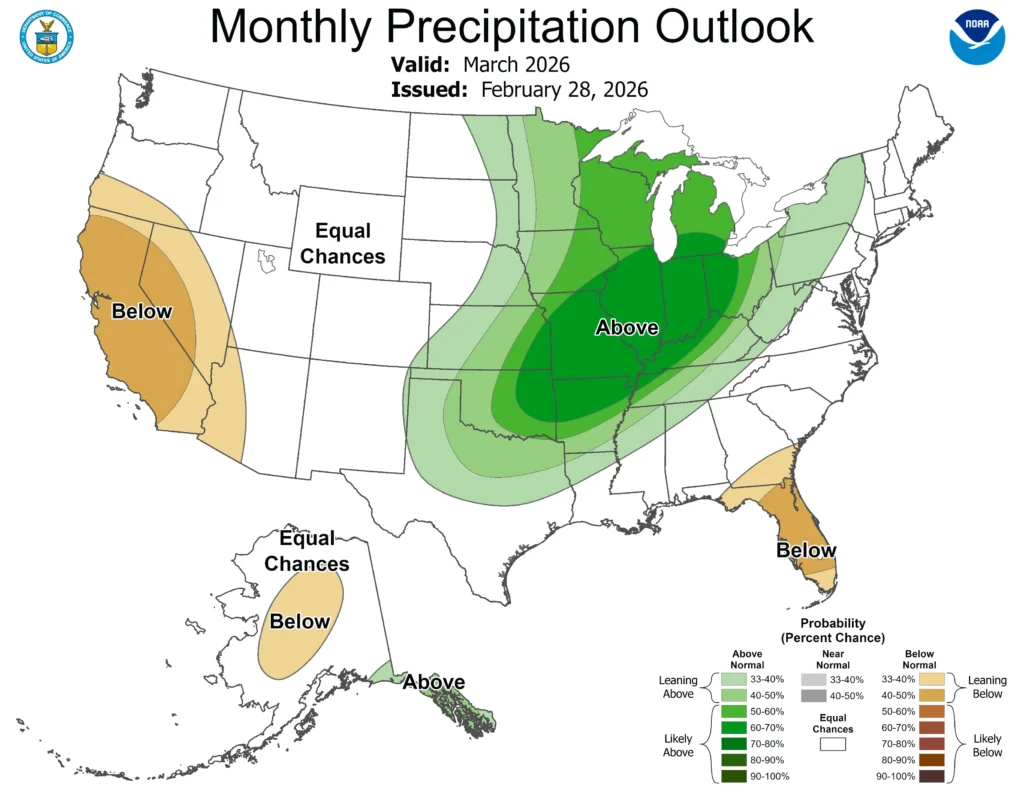
The Climate Prediction Center is expecting wetter than typical conditions for the Midwest this month. Missouri, Illinois, and Indiana are the most likely to see extra doses of precipitation, but Wisconsin’s chances are still high at a 50 to 60 percent chance of above-average precipitation.
The Averages:
In a true sign of spring, Wisconsin begins to see more frequent rain showers as opposed to snow showers during the month of March. The statewide average precipitation for the month is 1.82 inches, with an average snowfall total of 8.1 inches.
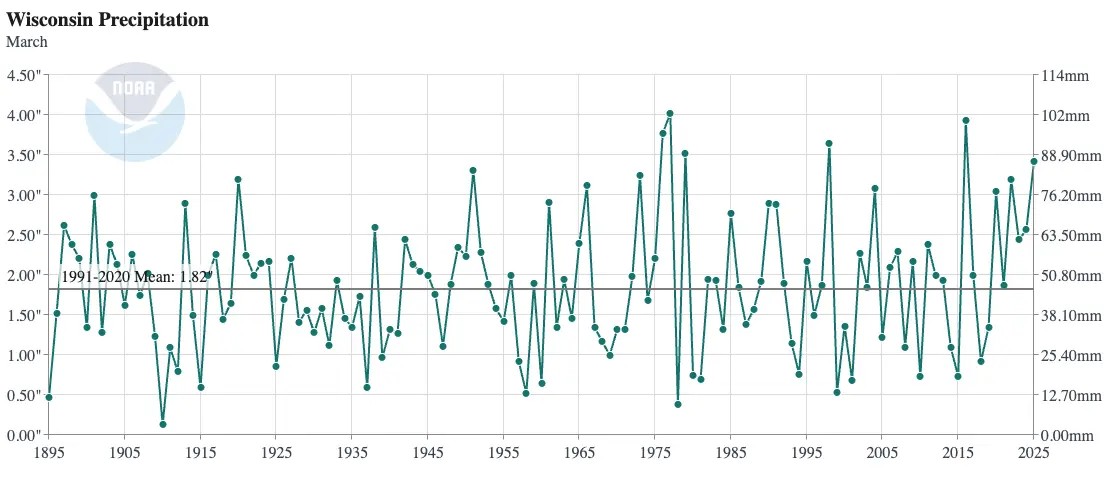
March of 1970 brought plenty of spring showers, making it Wisconsin’s wettest on record. The statewide average precipitation was just over four inches — more than double the monthly average.
Much of that precipitation fell in a rainstorm on March 3, 1970. Many areas in western Wisconsin received over an inch of rainfall that day, more than half of their average total for the entire month.
By contrast, March 1910 left Wisconsin parched with a statewide average precipitation total of just 0.13 inches. Precipitation fell on just one day in Eau Claire that month, amounting to a measly 0.01 inches. Madison, La Crosse, Milwaukee, and Wausau didn’t fare much better, with only two days with precipitation.
March 1910 was also the driest on record across the United States, and the spring season (March through May) would go on to rank as the country’s second driest.
This is a product of the Wisconsin State Climatology Office. For questions and comments, please contact us by email (stclim@aos.wisc.edu) or phone (608-263-2374).