Summers in Wisconsin are filled with all kinds of fun activities, such as festivals, farmers markets, baseball games, grilling out, and time spent on the water. Weather-wise, summer is climatologically the warmest and wettest season in the state.
When meteorologists and climatologists talk about the summer season, we’re using meteorological summer from the start of June through the end of August. The meteorological seasons slice the calendar year into four, three-month chunks based on the annual temperature cycle. This makes it easier to calculate seasonal statistics from year to year.
Temperatures
The Outlook: To Be Determined
NOAA’s Climate Prediction Center does not see strong signals favoring above-, below-, or near-normal temperatures for Wisconsin this summer. Outside the Midwest, warmer-than-normal conditions are possible. States in the west and northwest are showing a strong probability of experiencing above-normal temperatures in the summer months. The southwest US through the east coast are also leaning towards above-normal temperatures.
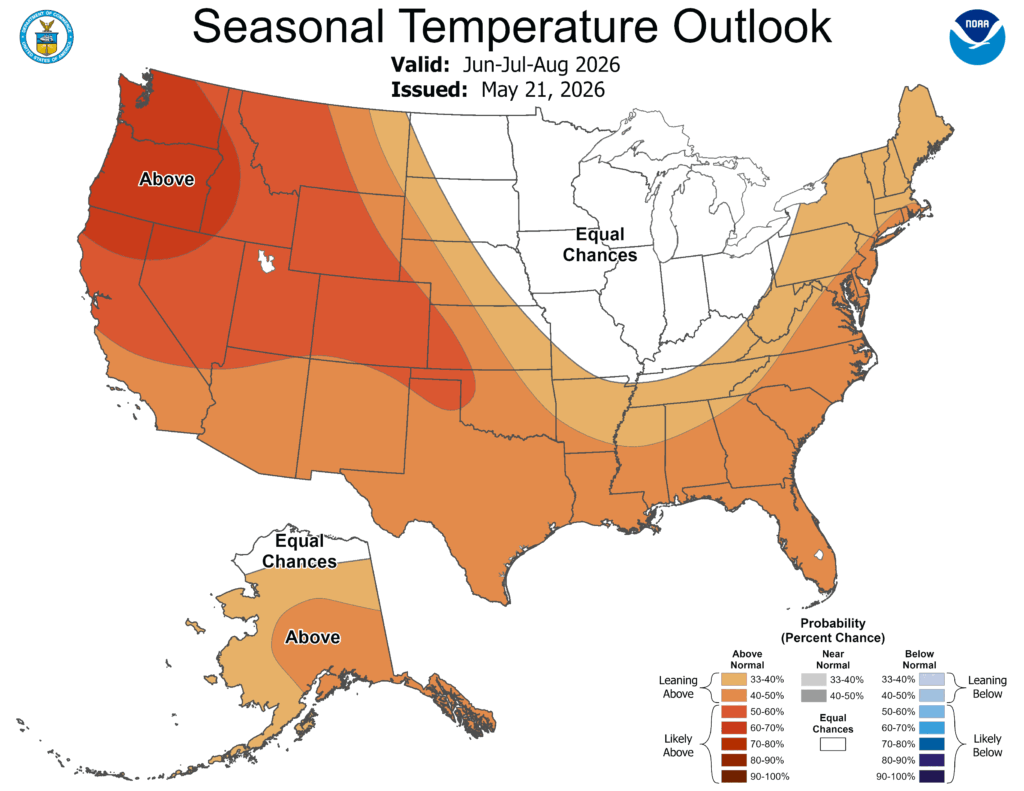
Note that the colors of the above map indicate the probability of above- or below-average temperatures, not the intensity of the expected warmth or cold. For example, most of Colorado has a 50 to 60 percent chance of above-normal temperatures across June, July and August.
Check out this blog for more information on deciphering climate probabilities.
The Averages:
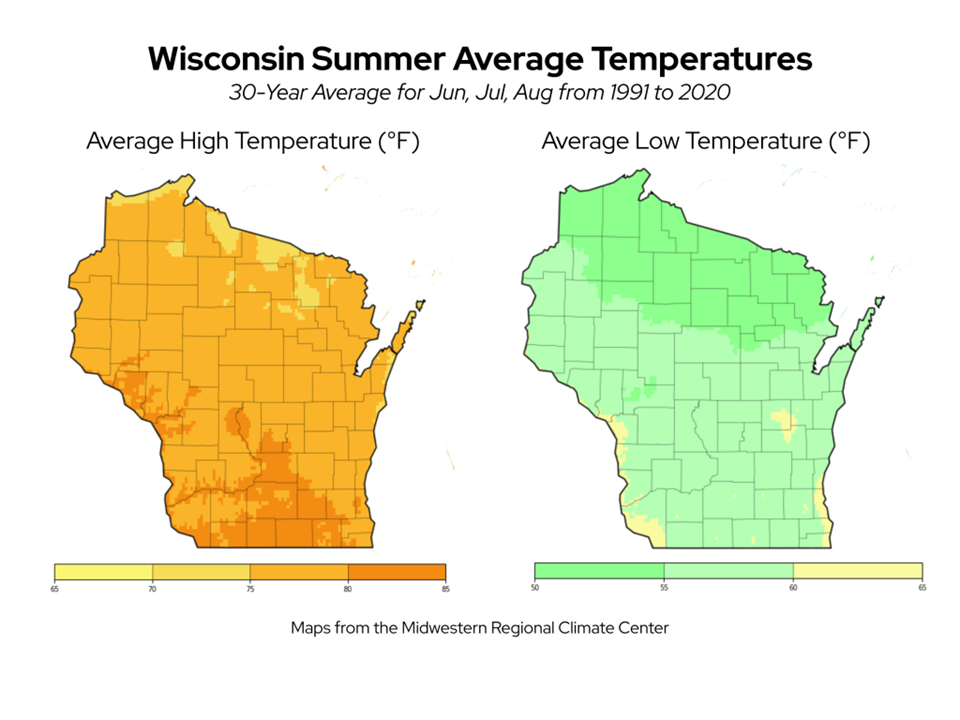
Wisconsin’s average summer temperature is 67 degrees Fahrenheit. Average high temperatures range from 75 to 80 degrees for most of the state. Average highs approach 85 degrees in portions of the south and west, and lean more towards the low 70s further north. Average low temperatures range from 55 to 65 degrees in the southern and central counties, whereas in northern counties, average lows range from 50 to 55 degrees.
The Extreme Seasons:
The summer of 1988 ranks as the warmest summer on record in Wisconsin. The statewide average temperature for the summer of 1988 was 70.5 degrees.
Madison, Milwaukee, La Crosse, and Eau Claire all set new records for the number of 100-degree days in a year in 1988, and those records have not been broken since. Eau Claire had the highest number of 100-degree days that year (nine), and Madison hit 100 for the first time in eleven years. The hottest temperature recorded that year was 108 degrees, both measured at the UW Arboretum in Madison and at Mount Mary University in Milwaukee.
The coldest summer in Wisconsin was in 1915, with a statewide average temperature of 62 degrees. None of Wisconsin’s six first-order stations reached 90 degrees in 1915. The hottest summer temperature recorded in the state in 1915 was only 95 degrees, measured in Waupaca and Stevens Point on July 13.
Precipitation
The Outlook: Leaning Dry in the Northwest
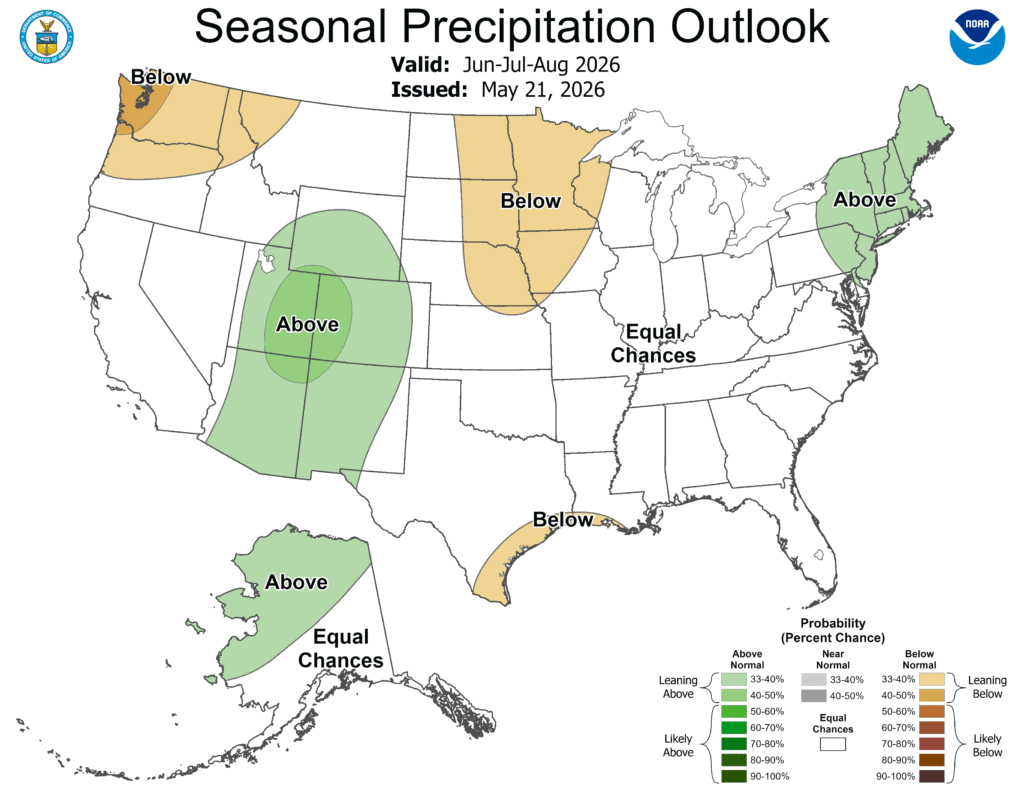
Most of the Badger State does not see strong signals for above-, below-, or near-average precipitation for this summer. However, in the northwest part of the state, there is a 33 to 40 chance of below-normal precipitation. This area of below-normal precipitation stretches west into Minnesota, Iowa, and the Dakotas.
The Averages:
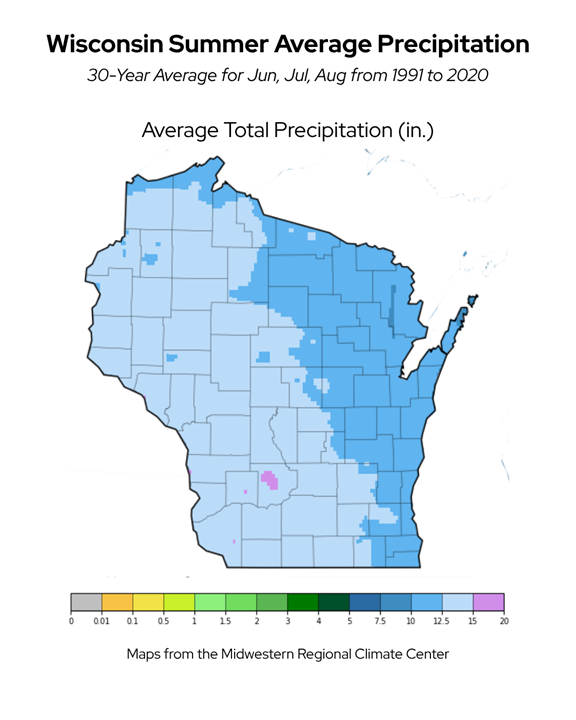
Wisconsin typically averages 12.64 inches of precipitation across the state in summer. Higher precipitation totals range from an average of 12.5 to 15 inches across the western half of the state, with lower totals averaging 10 to 12.5 inches in the east and north.
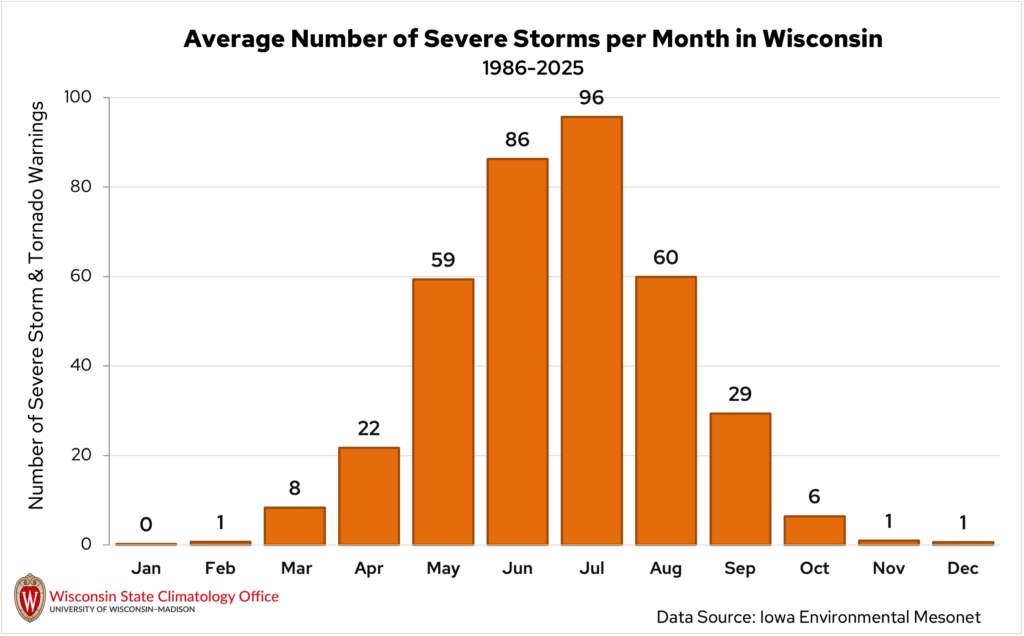
With warm summer temperatures and elevated humidity, the threat of severe weather goes up. Summertime severe storms can include hail, damaging winds, excessive rainfall, and tornadoes. Typically, summer is by far the season where severe storms are most frequent in Wisconsin, with July as the most active month for severe weather.
The Extreme Seasons:
Summer of 2010 ranks as the wettest summer on record in the Badger State. The average total precipitation in the state was 19.26 inches. The top three wettest cities in Wisconsin during the summer of 2010 were Reedsburg (27.95 inches), La Farge (27.83 inches), and Shorewood (27.38 inches).
Heavy rainfall impacted southern Wisconsin on July 22-23, 2010. Many locations received four to six inches of rainfall during these two days. The Milwaukee area was hit particularly hard by this event, with major flooding in the city. July 2010 still stands as the wettest July on record across the Milwaukee metropolitan area.
The driest summer in Wisconsin occurred in 1910, with a statewide average precipitation total of 6.51 inches. Janesville reported 1.15 inches for the entire summer in 1910. On Green Bay’s wettest summer day, the city received only 0.76 inches of rain (August 2). Milwaukee had only nine days where more than a quarter inch of rain fell.
This is a product of the Wisconsin State Climatology Office. For questions and comments, please contact us by email (stclim@aos.wisc.edu) or phone (608-263-2374).