May is often an exciting transition month, both in terms of our own daily lives and in our surrounding landscapes. Students near the end of the school year, spring blooms emerge, neighbors return to porches and patios, the sunlight lasts a whole lot longer, and the weather usually gets wetter and warmer.
Temperatures
The Outlook: Trending Cool
NOAA’s Climate Prediction Center is forecasting a chance for colder-than-normal temperatures this month. The entire Great Lakes region and the Ohio River Valley could experience a cooler May, while above-normal temperatures could be seen in the West.
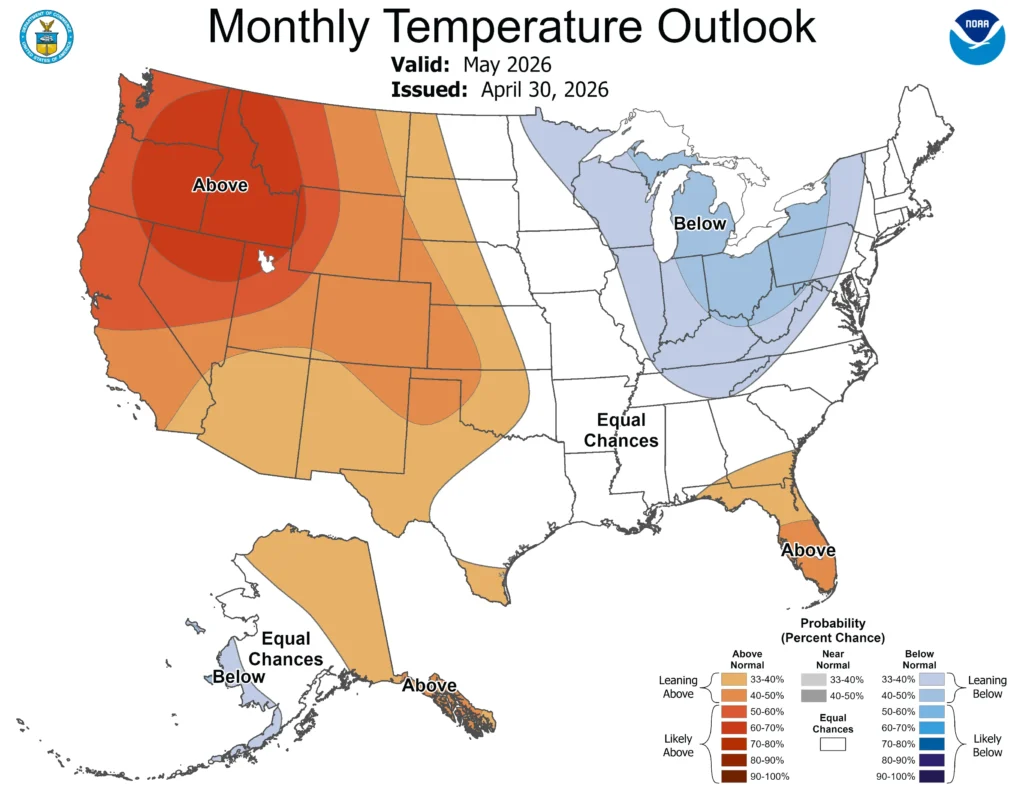
Note that the colors of the above map indicate the probability of above or below-normal temperatures, not the intensity of the expected warmth or cold. In this case, Wisconsin has a 33 to 40 percent chance of below-normal temperatures during May.
Check out this blog for more information on deciphering climate probabilities.
The Averages
Wisconsin’s temperatures often begin to lean more towards a summer feel during May, especially in the latter half of the month. Average high temperatures rise from the 60s to the 70s for much of the state, and lows rise above freezing. In fact, the statewide average low temperature for May is 43.6 degrees Fahrenheit.
| Location | Average Last Spring Freeze (32°F) |
|---|---|
| La Crosse | April 26 |
| Madison | May 3 |
| Milwaukee | April 22 |
| Green Bay | May 3 |
| Wausau | May 7 |
| Eau Claire | May 9 |
Dates of the final spring freeze vary from year to year and by location, but most often occur within the first week of May.
In recent decades, Wisconsin’s freezing season has ended earlier than usual, allowing the growing season to expand.
May 1977 was Wisconsin’s warmest May on record, with an average temperature of 63.0 degrees. Over two dozen locations reached the 90-degree mark during the middle of the month.
You may recall the more recent heat of May 2018, Wisconsin’s second-warmest May on record.
That month’s heat was less consistent than that of 1977, but it was more intense. La Crosse was among four other locations to reach a scorching 98 degrees on May 27, 2018. Green Bay saw a high of 97 degrees that day, the earliest that the city has ever exceeded 95 degrees.
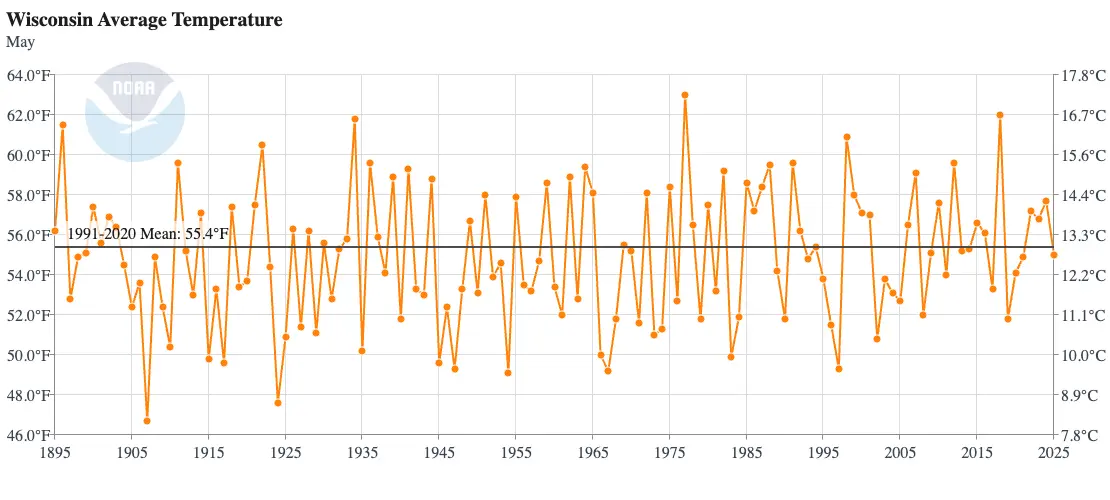
Wisconsin’s coldest May on record was back in 1907, when the average monthly temperature was 46.7 degrees — nearly nine degrees colder than normal. Sub-freezing temperatures stuck around in northern and central Wisconsin through late May that year. While it’s hard to find field reports from over 100 years ago, you can imagine that agricultural planting was likely way behind schedule that spring.
Precipitation
The Outlook: A Break from the Rain
The Climate Prediction Center expects that Wisconsin could lean drier than usual this May. Higher chances for below-normal precipitation are found in parts of Minnesota, the Dakotas, and northern Iowa.
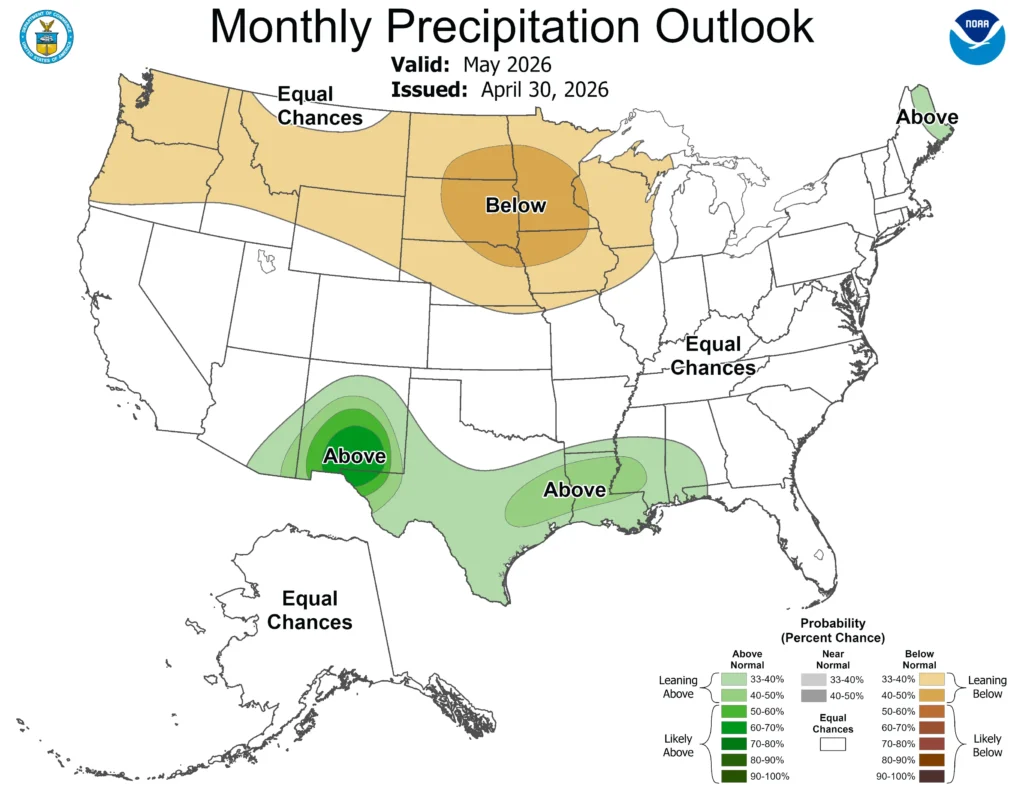
A chance of wetter-than-normal conditions in the southern United States could help alleviate drought conditions that have been steadily worsening over the winter and spring.
The Averages:
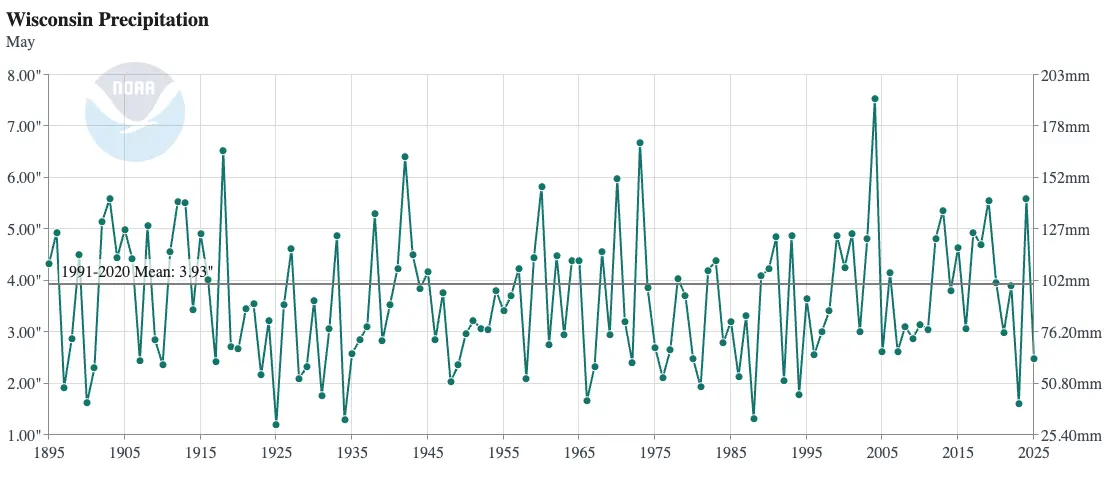
Of course, we know that April showers bring May flowers, but there should be a figure of speech for May showers, too! May is Wisconsin’s third wettest month (behind June and July) with an average statewide precipitation total of 3.93 inches.
With warmer temperatures, we can almost certainly count on May precipitation to fall as rain rather than snow or ice. However, some cooler Mays have brought snow to parts of the state: in 2006, snow fell in Wausau during the second week of May.
The Badger State’s wettest May was in 2004, when the statewide average precipitation was 7.54 inches — nearly double the monthly average.

Southern and central counties saw the highest totals. Areas in Crawford and Vernon counties in the southwest received more than a foot of rain that month, much of which came during a flash flood event on May 8.
May 1925 was Wisconsin’s driest, with statewide average precipitation only 1.20 inches. Both Madison and Wausau received less than a half inch of rain that month, and La Crosse saw less than an inch.
More recently, May 2023 ranked as Wisconsin’s fourth driest on record. Northern counties received the least amount of precipitation that month, but Madison and Milwaukee still saw monthly totals under an inch.
This is a product of the Wisconsin State Climatology Office. For questions and comments, please contact us by email (stclim@aos.wisc.edu) or phone (608-263-2374).