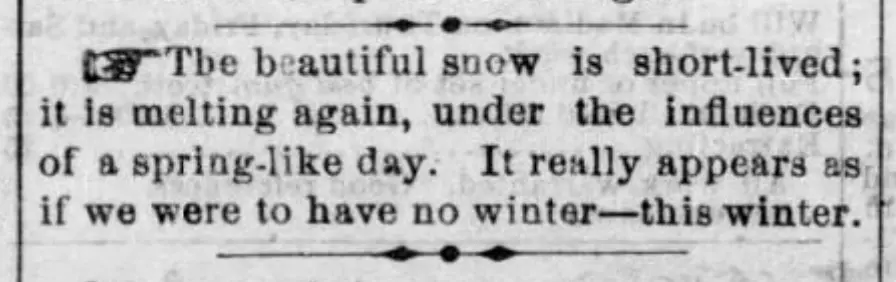
The winter of 2023 to 2024 was Wisconsin’s warmest on record, featuring low snowpack, temperatures reaching the 70s, and even severe weather. Some have even called it a “Lost Winter.” Though more than a hundred years ago, another Wisconsin winter was similarly lost: the winter season of 1877 to 1878.
Comparing Apples to Apples
Unfortunately, we can’t accurately compare statewide temperatures in 1877-78 to those in 2023-24 because there were so few weather stations back then. In 1877, only three Wisconsin weather stations were recording daily temperatures in La Crosse, Milwaukee, and Madison.
However, we can compare the two seasons at these locations. In 1877-78, La Crosse reported an average winter temperature of 34.2 degrees Fahrenheit, which remains the location’s highest winter temperature on record. The city’s 2023-24 temperature ranked second at 31.5 degrees.
The winter temperature reported in Madison that season also remains the highest reading at 31.7 degrees. During that December, the Capital City spent fewer than 180 hours below freezing (32 degrees), a record minimum that still stands. By comparison, 210 below-freezing hours were recorded in 2023-24, the city’s second warmest winter. Madison typically records about 560 hours below-freezing in December.
Milwaukee’s 1877-78 winter temperature was 32.0 degrees, ranking third warmest behind 2023-24 (34.7 degrees) and 1931-32 (32.6 degrees).
Newsworthy Warmth
While not official records, some local newspapers made note of the ongoing unseasonable warmth. The Oconomowoc Free Press published that temperatures in the region had fluctuated between 66 and 70 degrees the week before Christmas.
The Beloit Free Press conducted further analysis, comparing the city’s reported temperatures to those of the previous winter. They found that between November 22, 1877, and January 30, 1878, no morning temperatures were reported below zero degrees. During the same period the previous year, 21 mornings with below-zero temperatures were reported.
Wisconsin residents adjusted quickly to the lack of winter chill that season. The Waupun Times joked on January 29, 1878, “Seven degrees above zero yesterday morning and folks thought it was cold. Two or three years ago no one would have complained much at seventeen below.”
On Thin Ice
One winter indicator that doesn’t require a thermometer is the development and length of ice cover on Wisconsin’s bodies of water. The Republican-Journal newspaper of Darlington included local reports of ice-free rivers and streams in late December.
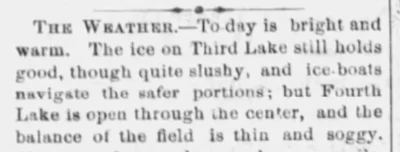
During the winter of 1877-78, the ice on Madison’s Lake Mendota lasted only 62 days, running from early January to early March. This remained the lowest duration on record until 1982-83.
Other lakes across Wisconsin lost their ice cover relatively early in 1878, with Lake Pepin along the Mississippi River reporting ice out on March 9, 1878, a record early date that stood until 2000.
The Growing Kept Going
Locations in Wisconsin and adjoining states also experienced a drastically extended growing season in the fall of 1877 and an early start to the growing season in the spring.
The fall’s first 32-degree temperature reading wasn’t until November 3 in Madison and La Crosse. The Republican-Journal reported local farmers easily plowing fields in Darlington on December 28, with frost not yet in the ground.
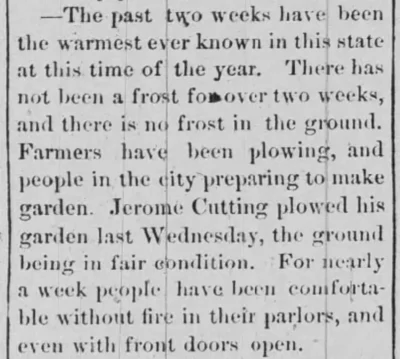
The segment also noted that several cherry trees were blooming. An early settler in Milwaukee reported that his fruit trees had budded in February. In the spring, Madison and Milwaukee had their last freezing temperature of the season on March 29. This date remains the earliest end of the freeze season in both cities.
Despite the extended season, some growers struggled to transport their produce to area markets. The lack of frozen ground made roads and paths extremely muddy. Many found holiday travel nearly impossible due to the thick muck.
The Waukesha Freeman published one anecdote on December 27, 1877: “Mud before, behind and under you, mud everywhere and such mud, the muddiest mud possible and it sticks like a bad reputation.” One can imagine the state of wagons and horses after a trek through such conditions!
Why Was the Season So Warm?
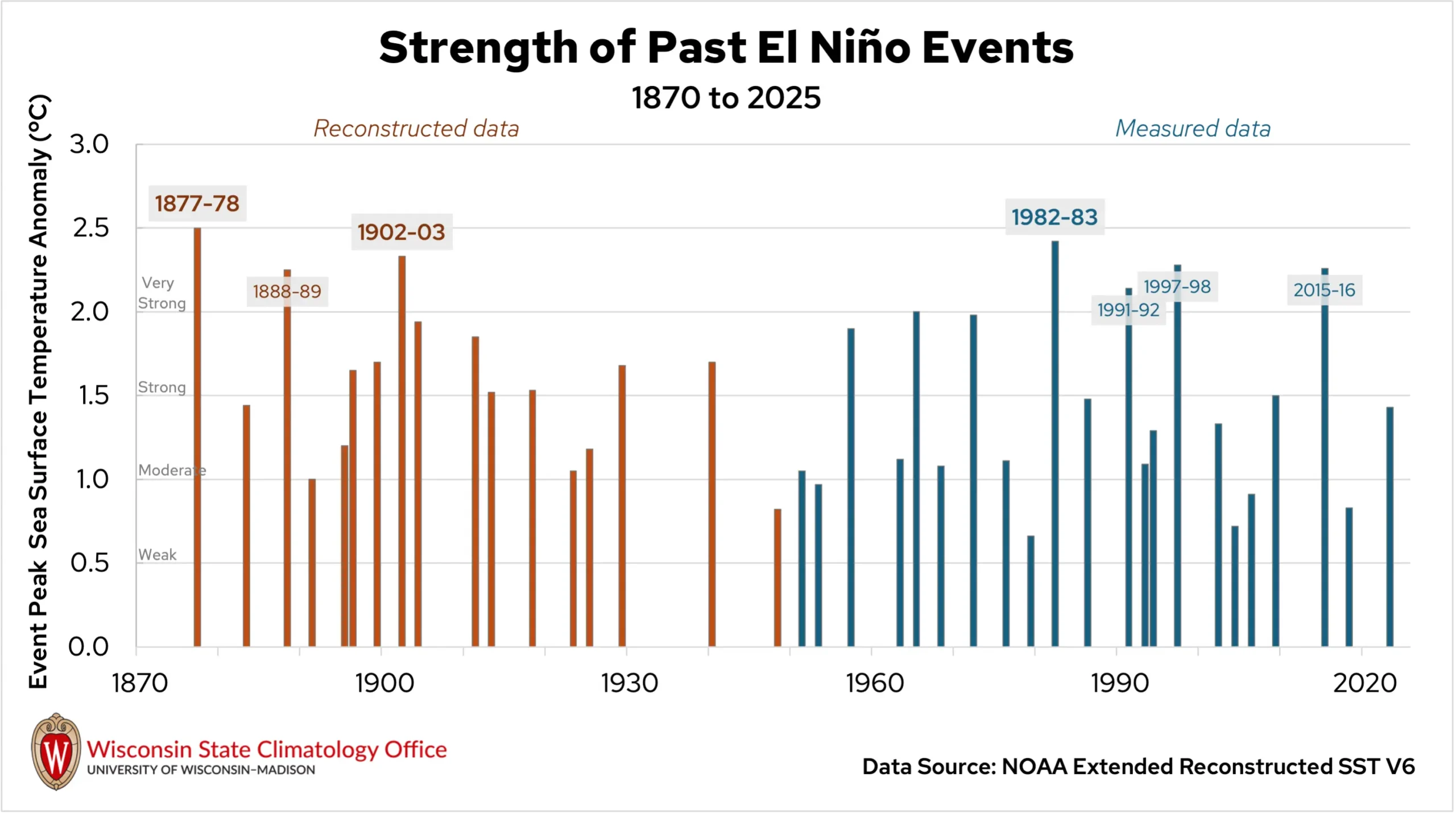
Scientists found that the record warmth was primarily due to a very strong El Niño event, which remains among the most powerful on record.
El Niño strength depends primarily on the magnitude of the ocean temperature anomalies in the equatorial Pacific. An El Niño phase requires the temperature anomaly in this region to be at least 0.5 degrees Celsius warmer than average. Events that are considered “very strong” have anomalies of 2.0 degrees Celsius or greater. Reliable ocean temperature data became available in 1950, but researchers have used ship observations to extend records back further.
In 2022, Eric Webb and Brian Magi at the University of North Carolina at Charlotte developed records back to 1850. Their findings revealed that the 1877-78 El Niño event was exceptionally strong, with estimated ocean temperature anomalies greater than 2.5 degrees Celsius.
However, our 21st-century climate is very different from that of the 19th. Over the last several decades, global temperatures have been increasing. The combined effects of El Niño and an increasing temperature trend have been more pronounced, often exacerbating impacts during Wisconsin’s winters.
A moderate El Niño was at play in 2023-24, which helped make it Wisconsin’s warmest winter since 1895. Several other strong El Niño events in recent decades occurred in 1982-83, 1997-98, and 2015-16, also resulting in extreme winter warmth in our state.
However, unseasonably warm winters are not always a direct result of El Niño. For example, Wisconsin experienced its second-warmest winter on record in 2001-02 when no El Niño was present.
Similarly, El Niño does not always result in a mild winter. A strong event was at play during the winter of 2009-10, a season that was both colder and snowier than normal. El Niño is one piece of the puzzle that shapes Wisconsin’s winter weather, and sometimes other pieces outweigh it.
This is a product of the Wisconsin State Climatology Office. For questions and comments, please contact us by email (stclim@aos.wisc.edu) or by phone (608-263-2374).