By early October, when a spell of summer-like weather returns to Wisconsin after a cool spell of September weather, people often ask, “Is this a second summer?”
Its occurrence does not represent just any warm, summer-like day in autumn, but must conform to certain criteria.
A second summer only happens when a string of warm and pleasant autumn days occurs after the first fall freeze.
Some say it must be a sustained warm spell of at least seven consecutive days, with daytime highs above 70 degrees Fahrenheit and nighttime lows above 32 degrees. Plus, the weather must remain dry.
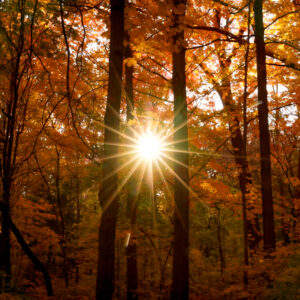
With these criteria, a true second summer in Wisconsin typically occurs from late September through early November. The bright sunshine of second summer enhances the jewel-like hues of Wisconsin’s autumn leaves and can extend the apple harvest season.
Background of the Term
Although “second summer” is not a specific meteorological term, its usage over the last 20 years is as an alternative to the outdated and culturally insensitive term, “Indian Summer.”
While the origin of the term Indian Summer is uncertain, it was used as part of regional folklore across the northern U.S. predating the Civil War. It’s said that Native Americans described the spell of pleasant, mild, and dry weather that interrupts the typical seasonal cooling trend as a time that allowed them to hunt and harvest crops as they prepared for winter.
While this explanation primarily describes an American weather pattern, the European equivalent of Second Summer is termed “Old Wives Summer.” In England, the event is known as either “St. Luke’s Summer” (in October) or “St. Martin’s Summer” (in November) depending on the date of occurrence.
Weather Patterns of Second Summer
A second summer’s sufficiently warm and dry weather is often caused by a large high-pressure system that develops and stalls over eastern North America in mid to late fall. This pushes the jet stream to north of the Midwest and allows warm air to spread across the region.
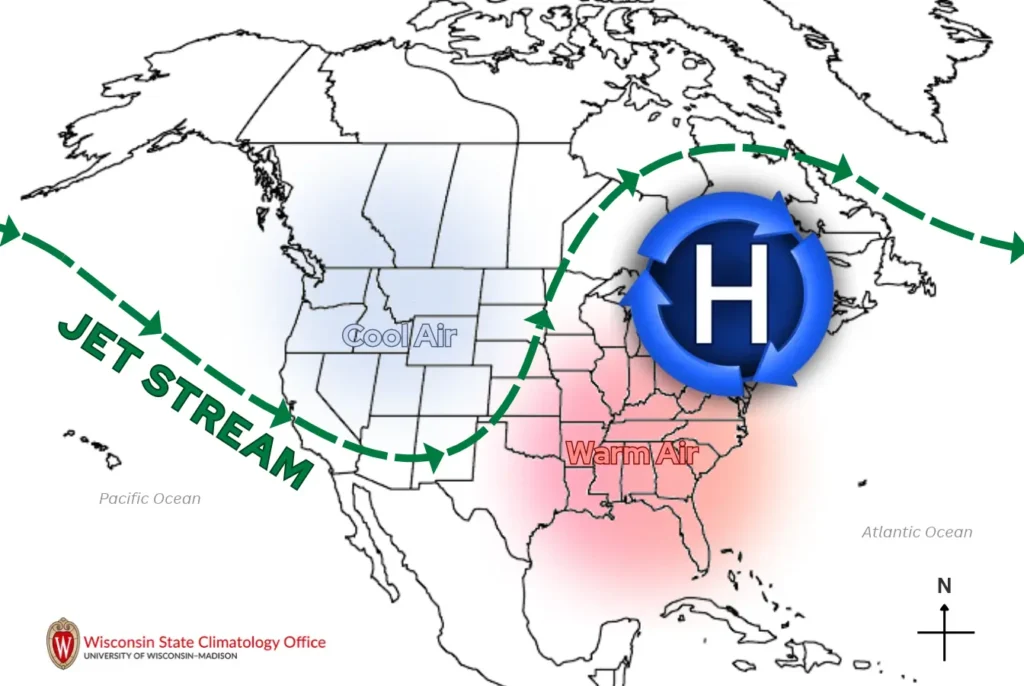
The dominant high pressure over the region creates nearly calm, stable conditions. Thus, relatively cloud-free skies are the standard. The typically clear skies at night bring cooler temperatures, due to radiational cooling.
Usually, this high-pressure system weakens after a week or so, and drifts toward the southeast. The weather that follows can often feel like a rude awakening after a warm, pleasant stretch.
As high-pressure moves southeast, winds over Wisconsin shift to be out of the west and northwest. This causes regional air temperatures to cool and the jet stream to return to its position south of Wisconsin. The colder air moving across the Upper Midwest becomes destabilized as it passes across warmer ground and the Great Lakes, resulting in clouds and precipitation (oftentimes, falling as snow).
Frequency of Second Summers
Since there’s no rigid criteria for second summers, it’s difficult to definitively say how often Wisconsin has experienced the phenomenon.
Wisconsin Department of Natural Resources researcher Richard Kalnicky provided some sense of this second summer’s frequency and length. He analyzed daily autumn weather observations from 1898 to 1997 in Medford (Taylor County), New London (Waupaca County), and Madison (Dane County).
While Kalnicky based his analysis on the occurrence after the season’s first freeze and the need for dry weather, he used slightly different thresholds than described above. He looked at days with a maximum temperature of at least 65 degrees and a minimum temperature above 33 degrees.
By these criteria, Kalnicky determined that a second summers had occurred in Wisconsin as early as August 31 and as late as November 19. This summer-like spell is most frequent from the end of September through the first three weeks of October.
Statewide, Wisconsinites experience an average of eight second summer days each autumn. One of the longest recorded second summers in southern Wisconsin lasted 11 days in October 1947. Sometimes, multiple separate episodes occur in one autumn season, while other times, no true second summer develops.