
The hallmark of October may be the changing and falling of the leaves, but it’s also a milestone month in the weather department. Many areas in Wisconsin will see their last 80-degree temperatures during October, followed by the first frosts and freezes that end the growing season. Some places may even see their first snowflakes of the season by the end of the month!
Temperatures
The Outlook: Possibly Mild
NOAA’s Climate Prediction Center is forecasting a chance for temperatures to lean warmer-than-average in western and north-central Wisconsin this month. The outlook shows equal chances of above, below, or near-average temperatures across the rest of the state.
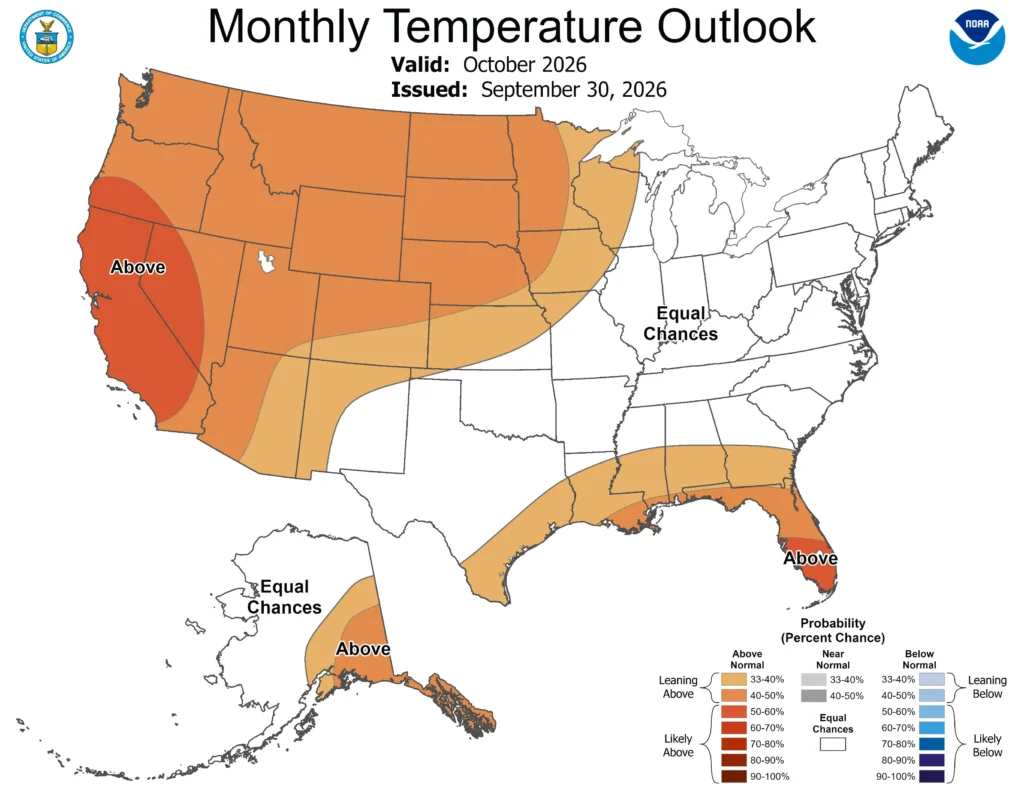
Note that the colors of the above map indicate the probability of above or below average temperatures, not the intensity of the expected warmth or cold. In this case, western Wisconsin has a 33 to 40 percent chance of experiencing above-average temperatures. Check out this blog for more information on deciphering climate probabilities.
The Averages:
With fewer bursts of summer heat compared to September, October is typically when some chill begins to settle into the state. Wisconsin’s statewide average temperature during the month is 46.8 degrees.
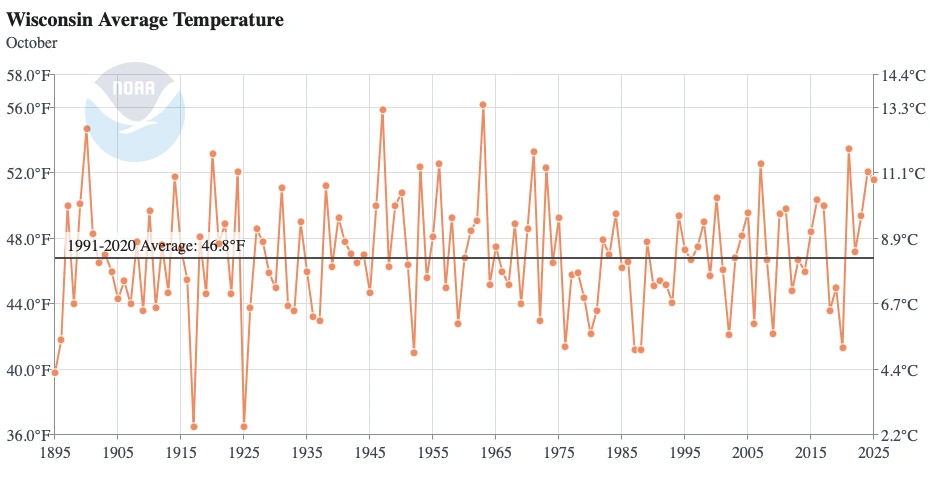
That’s not to say that October can’t pack a punch of heat once in a while! The hottest in Wisconsin was 1963, when the statewide average high temperature for the month was a toasty 68.5 degrees.
| Location | High Temperature (ºF) on October 6, 1963 |
|---|---|
| La Crosse | 93 |
| Madison | 90 |
| Milwaukee | 89 |
| Green Bay | 88 |
| Wausau | 87 |
| Eau Claire | 84 |
October 6 was the hottest day of the month, when many southern cities reached the 90s — including places along the lakeshore, like Sheboygan!
La Crosse, Madison, Milwaukee, and Green Bay all set or tied records for their warmest October temperature that day.
The coldest Octobers on record were in 1917 and 1925, when the state’s average temperature was 36.5 degrees, with an average high temperature below 45.
During both of those years, locations saw the mercury fall to the single digits, but 1925 featured sub-zero temperatures for some. Rest Lake in Vilas County recorded the state’s coldest October temperature of 6 degrees below zero.
Precipitation
The Outlook: Leaning Dry
The Climate Prediction Center is forecasting a chance for drier than normal conditions across much of central and northern Wisconsin this month, with far northwestern Wisconsin seeing slightly higher chances. This is an unfortunate outlook for these drought-stricken areas, as October moisture would greatly help replenish soil moisture before the winter season.
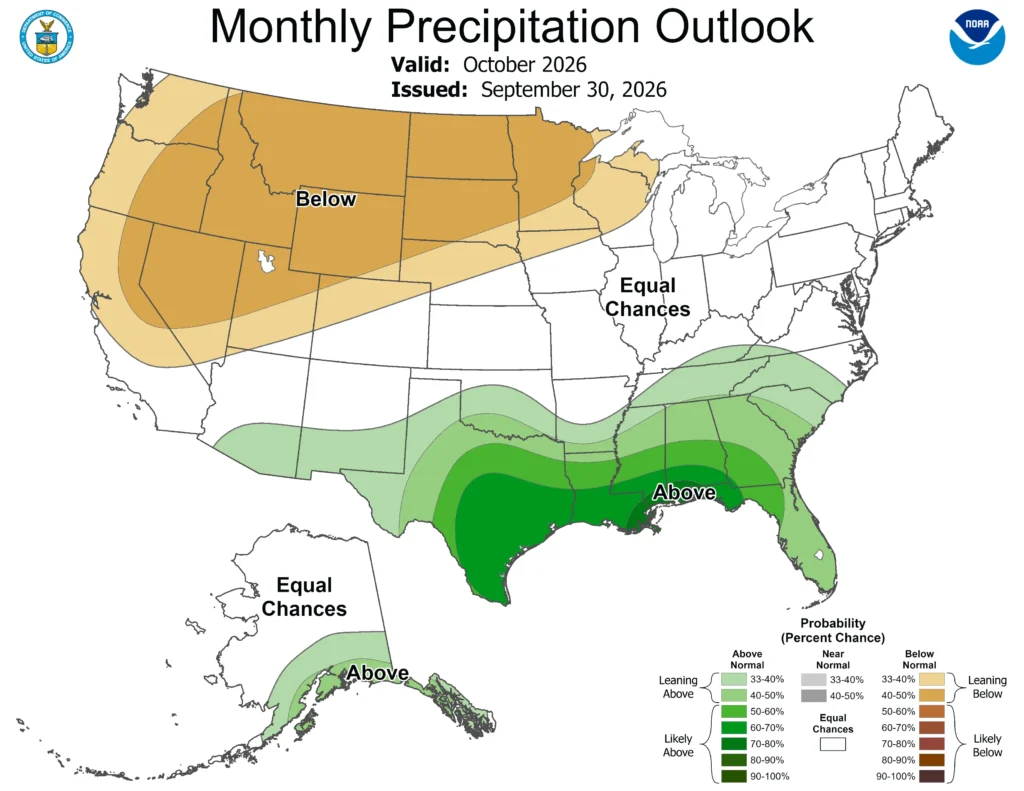
For the southern and far eastern counties, there is no significant precipitation signal, giving these areas equal chances of experiencing above, below, or near-average conditions.
The Averages:
Stretches of dry weather are common in Wisconsin through October, as evidenced by the state’s average monthly precipitation of only 3.01 inches. However, with cooler temperatures moving in, that precipitation doesn’t always fall as rain!
The cold October of 1925 doubled as one of the snowiest on record in some parts of the state, including in Eau Claire, La Crosse, and Madison, where over five inches of snow fell.
The wettest on record was October 1900, when the statewide average precipitation was just over six inches! Western and central Wisconsin were inundated with rain that month — La Crosse totaled 12.09 inches for the month, while Wausau measured under 11 inches.
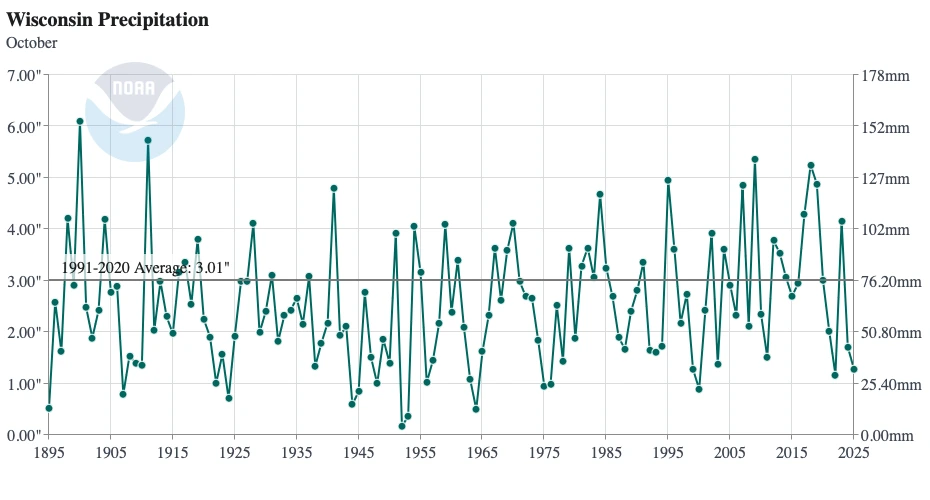
On the other end of the spectrum, October 1952 brought a statewide average of 0.17 inches of precipitation to the state. Wisconsin wasn’t alone in the drought; that month went down as the United States’ driest month on record, with only 0.54 inches as the average precipitation across the country.
Many cities across Wisconsin saw deficits of 2.5 to 3.5 inches, or as little as five percent of October’s average precipitation. After only trace amounts of precipitation were measured, October 1952 remains Green Bay’s driest month on record.
This is a product of the Wisconsin State Climatology Office. For questions and comments, please contact us by email (stclim@aos.wisc.edu) or by phone (608-263-2374).