Wisconsin is kicking off July 2026 with very fitting weather — unseasonably hot temperatures and Florida-like humidity! The official ‘dog days’ of summer begin on July 3 and continue through August, marking what’s usually the hottest period of the year for the northern hemisphere.
Temperature
The Outlook: To Be Determined
NOAA’s Climate Prediction Center does not see a consistent temperature pattern in Wisconsin in July, forecasting equal chances of above, near, or below-average temperatures.
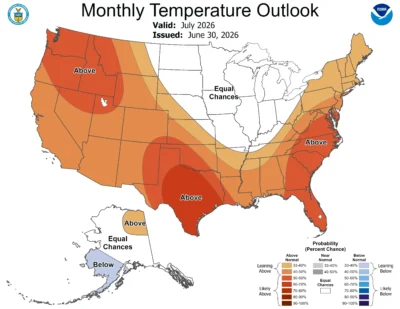
Note that the colors of the above map indicate the probability of above or below normal temperatures, not the intensity of the expected warmth or cold. For example, Texas has a 60 to 80 percent chance of warmer-than-average temperatures in July.
Check out this blog for more information on deciphering climate probabilities.
The Averages:
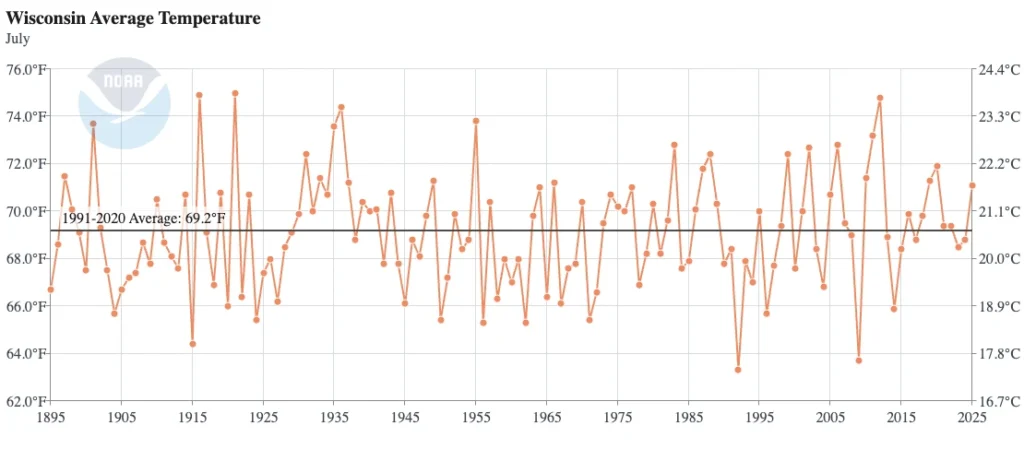
July is usually the hottest month of the year in Wisconsin, with a statewide average temperature of 69.2 degrees Fahrenheit. If you’re looking for a nice, hot beach day, July 19 is your best bet — historically, that’s Wisconsin’s hottest day of the year!
Of course, we know that summer heat is often accompanied by intense humidity. Dew points of 70 degrees or higher are common in July, especially in Wisconsin’s southern and central regions. Pair that with a high temperature in the 80s, and feel-like conditions can approach 90 degrees very quickly.
| Location | Average Number of Hours with Heat Index ≥ 90°F in July |
|---|---|
| La Crosse | 60.2 |
| Madison | 43 |
| Eau Claire | 38.3 |
| Milwaukee | 37.9 |
| Green Bay | 29.7 |
| Wausau | 19.2 |
The hottest July on record in Wisconsin was back in 1921, when that statewide average temperature was 75.0 degrees. Interestingly, the hottest conditions of that month occurred in central Wisconsin. Waupaca reached a scorching 106 degrees, and Stevens Point reported a maximum of 102 degrees. Wausau reached 101 degrees on July 7, 1921, which remains the city’s fourth hottest temperature on record.
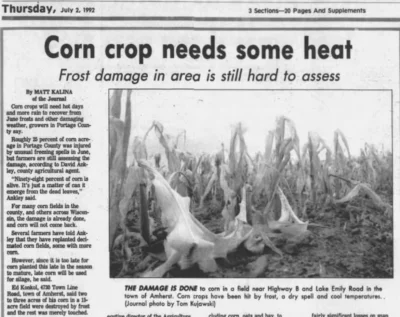
The coldest July was in 1992, when freezing temperatures struck parts of the state mid-month! Even counties in central Wisconsin reported temperatures in the upper 30s.
The crops in Wisconsin were already in a bad state after unseasonably late frosts in June. According to the U.S. Department of Agriculture, despite a 20 million-acre increase in corn planted in the state, Wisconsin’s corn yields were 20 percent lower in 1992 than in 1987.
Precipitation
The Outlook: Leaning Dry for Some
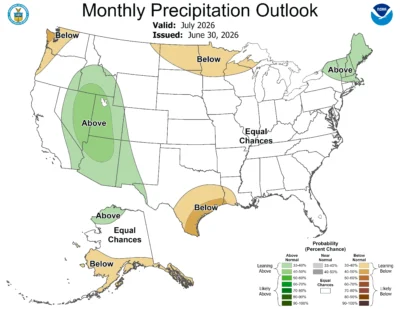
Similar to the temperature outlook, the Climate Prediction Center sees equal chances of above, near, or below-average precipitation in July for most of Wisconsin. Only the far northern counties of the state are highlighted as having a chance to learn drier than average this month.
The Averages:
July is usually slightly drier than June, with a statewide average precipitation of 4.04 inches. Much of that precipitation often comes in heavy downpours of thunderstorms. July is typically the most active severe weather month in Wisconsin, with an average of 98 severe storms in the state.
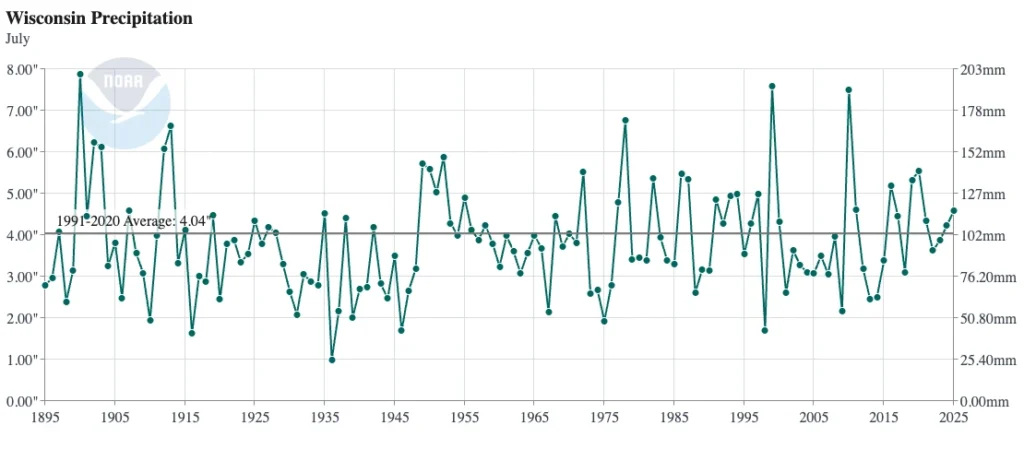
Wisconsin’s wettest July was in 1900, when many locations received more than seven inches of rainfall. Central Wisconsin was the bullseye, with Price and Marathon counties reporting over a foot of rain during the month.
July 1936 brought extreme drought to Wisconsin and to much of the nation. Intense summer heat and severe lack of rain kick-started the infamous Dust Bowl. Wisconsin’s statewide average rainfall for July was 0.99 inches, and 33 of the state’s 72 counties experienced their driest July on record.
This is a product of the Wisconsin State Climatology Office. For questions and comments, please contact us by email (stclim@aos.wisc.edu) or phone (608-263-2374).