On October 1, 1851, the first Wisconsin State Fair was held along the Rock River in Janesville. For opening day, fairgoers couldn’t have asked for better early October weather: a weather observer in Beloit (15 miles south of Janesville) reported temperatures in the 70s with dry conditions. The daily admission cost just 10 cents (equal to about four dollars in 2026), and 10,000 people attended over the two days of the event.
Over the last 175 years, the state fair has undergone some big changes. The fair’s location changed during the first 40 years, with stints in Janesville, Watertown, Madison, Fond du Lac and Milwaukee. In 1892, a permanent home was found in the Milwaukee suburb of West Allis.

By the 1920s, the fair’s date had shifted from early October to late August, and it had expanded to six days. In 1979, the fair shifted to the first week of August to accommodate school schedules.
In recent years, the grounds host an average of one million fairgoers over the now 11-day event. The many attractions range from the display of home-grown agricultural products to food, including the famous cream puffs, to a variety of entertainment for all ages. According to recent estimates, the Wisconsin State Fair annually generates an economic impact of more than $200 million for the state.
Of course, weather has a major impact on fair attendance. Shifting the event dates from October to August introduced frequently hotter conditions and greater chances of rain and thunderstorms. During Wisconsin’s hottest summer in 1988, the fair saw its lowest attendance of the decade. Similarly, in 1995, intense August heat resulted in 10 percent fewer fairgoers compared to the decadal average.
Fair (And Not-So-Fair) Weather
Daily temperature and precipitation data collected from the nearby NOAA West Allis cooperative observer station were used to determine early August climatology. Data for this location began in 1948, though no observations were reported from 1949 to 1951 and 1988 to 1998.
Additional data were obtained from the official climate station for Milwaukee, the Milwaukee Mitchell International Airport. Since the airport is close to Lake Michigan, the cool onshore lake breezes often provide slightly cooler temperatures in the summer than locations farther inland like West Allis.
Temperatures
The average high temperature in West Allis during the first half of August is just below 84 degrees Fahrenheit, with an average low temperature around 63 degrees.
The Milwaukee area tends to experience the highest humidity levels and highest temperatures during July and August. Since 1948, the average highest heat index at Milwaukee Mitchell Airport in August is 98 degrees.

The hottest temperature recorded in West Allis during the state fair was a scorching 101 degrees on August 24, 1948. This was during Wisconsin’s Centennial Exposition that ran for 23 days to honor the 100th anniversary of Wisconsin’s statehood.
The longest string of consecutive 90-degree days in West Allis is 10, running from August 22 to September 3, 1953. Part of this streak occurred during the 1953 fair, which ran from August 22 to August 30. Surprisingly, fair attendance that year was the largest of the decade.
The lowest temperature experienced in West Allis during the first half of August was 47 degrees on August 15, 2004, the last day of the fair that year.
Precipitation
Regardless of the exact timing of the Fair, some rain can be expected during the event. The average daily rainfall totals (1991-2020 normals) for West Allis during the first half of August are nearly 0.14 inches per day. Some amount of rain can be expected on only 33 percent of August days, occurring on 10 days on average.
The largest amount of rain to fall in West Allis for the entire month was 10.51 inches in August 2025, the majority of which fell during the record event on August 9 and 10.
In 1980, rain fell on six days of the fair, which ran from July 31 to August 10, amounting to 4.35 inches.
Conversely, the lack of rain could be accompanied by higher temperatures and make the grounds exceptionally dusty. August 1948 was the driest August on record in West Allis, with 0.45 inches of rain for the month and only 0.05 inches during the first fifteen days.
Major Weather Events
1955’s Extreme Heat
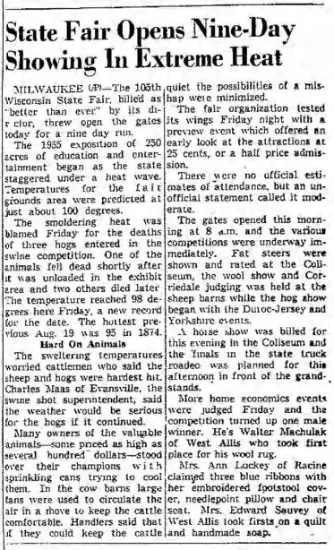
The 105th Wisconsin State Fair in 1955 began with scorching heat. Temperatures on the August 19 opening day reached 98 degrees Fahrenheit in West Allis, creating dangerous conditions for both fairgoers and livestock. The Sheboygan Press newspaper reported the heat was blamed for the death of three hogs.
Temperatures remained steamy on day 2, and peaked on day 3. West Allis reached 99 degrees on August 21, with the nearby Milwaukee Mitchell Airport at 100 degrees — a daily record that still stands.
Fair attendance that year was down 20 percent from the decade normal (about 140,000 fewer people), but much of that was likely tied to the polio epidemic.
The Tornado of 1969
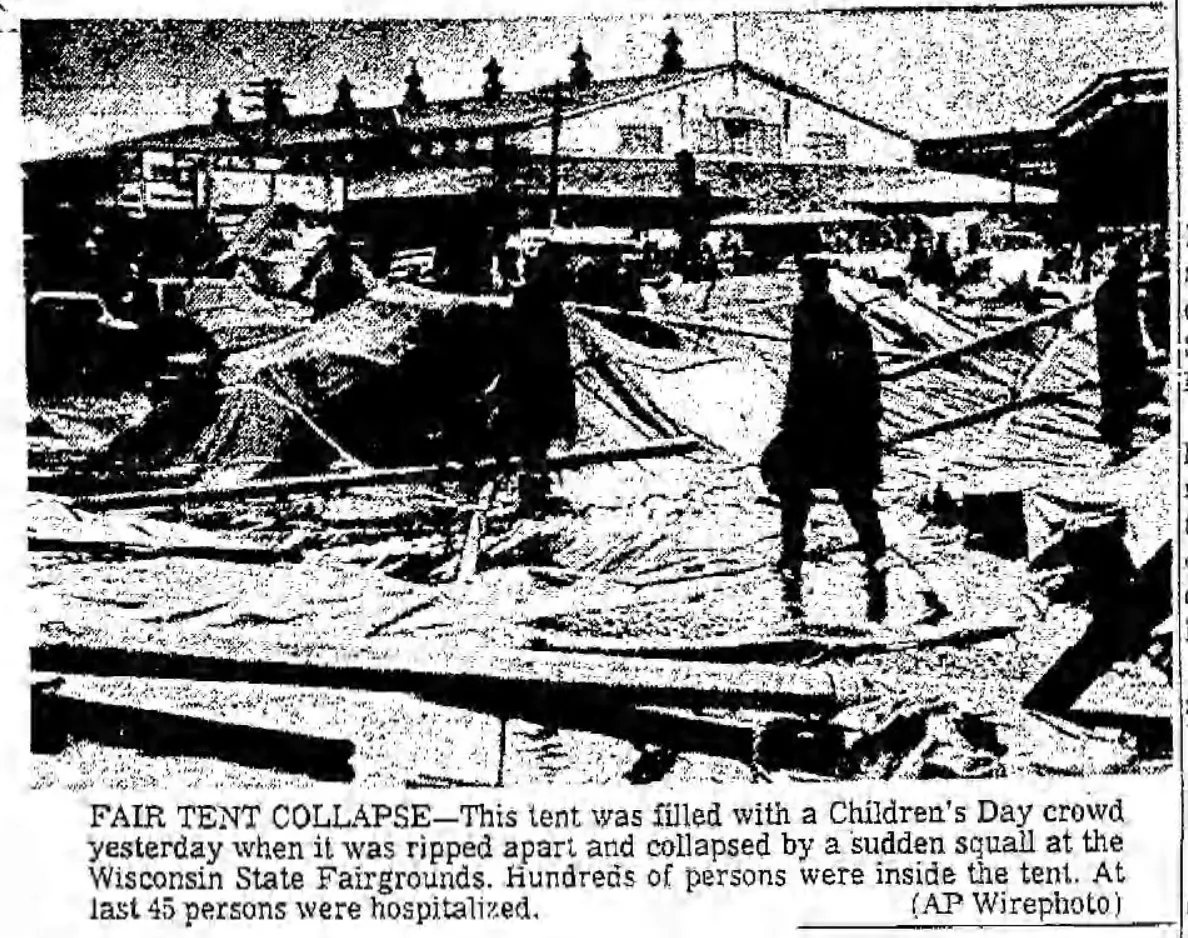
On the late afternoon of August 11, 1969, the fourth day of the fair, a tornado struck Fair Park. The tornado was rated at F1 strength and could have had winds up to 112 miles per hour. The storm’s path of destruction was relatively small, only about 100 yards wide and nearly one-third of a mile long.
News reports say that the day’s weather started calm and sunny in West Allis. Children’s admission was free that day, and just over 100,000 people were said to be in attendance.
As the storms rolled in, chaos ensued as attendees sought shelter in the large exhibit tents. Off-duty Milwaukee police officer Lonnie Heibler was quoted as saying, “There was a terrible panic. People were trampled all over the place.”
The hurricane-strength winds collapsed three tents and took down power lines across the grounds. At least 150 people were hurt, though most were reported as minor injuries. The Wisconsin Rapids Daily Tribune reported that two boys were hospitalized with head injuries.
Late Night Storms in 2021
In 2021, a complex of storms blew through just as the fairgrounds were closing for the night. Around midnight on August 11, a line of storms rolled in from the west, producing heavy rain and wind gusts of 50 to 70 miles per hour.
While no significant damage was seen on the grounds, many vendors were caught unprepared for the strong winds, and some midway rides shut down for the night. Damage reports from the surrounding area included uprooted trees in West Allis, downed power lines in Whitefish Bay, and a large tree snapped in Waukesha County.
2025’s Historic Flood
A historic torrential rain in southeast Wisconsin on August 9, 2025, created flash flooding, causing the grounds to close early. More than six inches of rain fell across the Milwaukee metro between 2 and 8 P.M. West Allis reported nearly nine inches of rain, making it a 1000-year event for the city.

As fairgoers tried to exit Fair Park, they were met with flooded sidewalks and roads. In some spots, the floodwater reached the headlights of vehicles.
Organizers cancelled the following day of the fair due to damage and debris strewn across the grounds. No injuries were reported at the fairgrounds, and no animals were reported hurt.
This rain event resulted in a new state record for the largest 24-hour rainfall after 14.55 inches of rain was measured on the northwest side of Milwaukee.
This is a product of the Wisconsin State Climatology Office. For questions and comments, please contact us by email (stclim@aos.wisc.edu) or phone (608-263-2374).