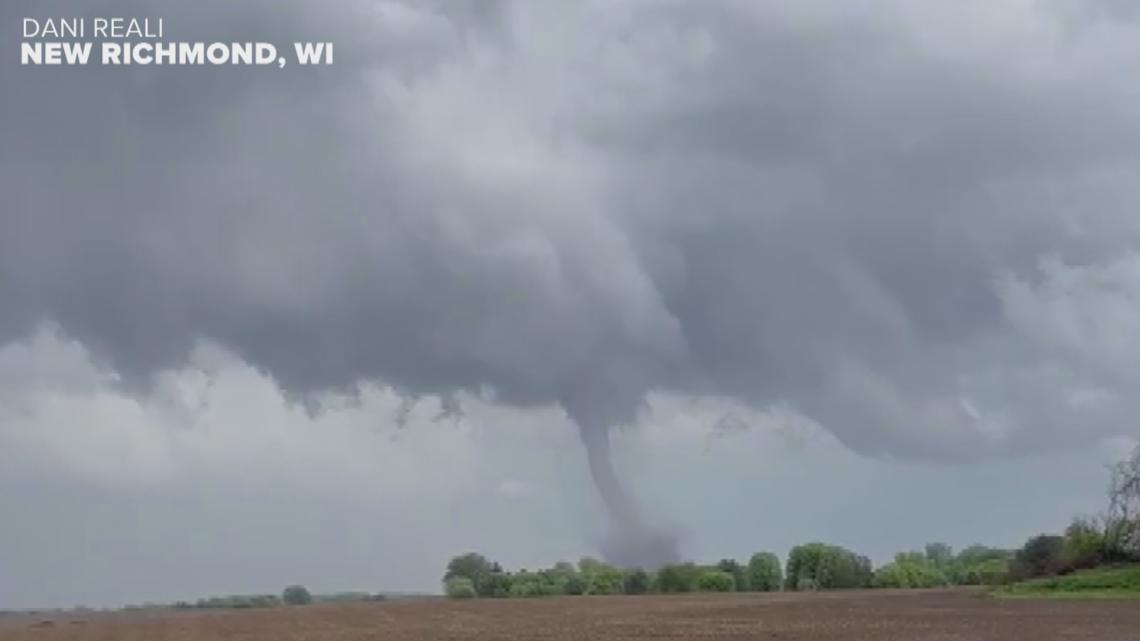
Tornadoes, perhaps one of the most daunting weather phenomena, have been recorded on every continent except Antarctica. However, they occur most frequently in the United States. The U.S. averages about 1,000 tornadoes per year, 10 times as many as runner-up Canada.
Wisconsin has experienced its fair share of tornadoes, recording 1,596 tornadoes between 1950 and 2025.
What is a tornado?
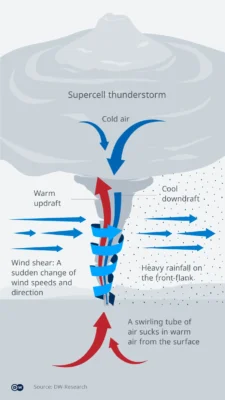
Tornadoes are fast-spinning columns of air that form in thunderstorms and extend to the ground. They form when storm winds begin moving in different directions and at different speeds, causing the air caught between them to rotate.
Rising warm air and sinking cold air can strengthen the rotation of the twister. Since they are funnels of air, tornadoes can be hard to spot, unless dirt or debris gets caught in them.
By definition, a tornado must make contact with the ground. When what looks like a tornado begins emerging from a thunderstorm cloud but is still high above the ground, it’s called a funnel cloud. Harmless cold air funnels can sometimes develop in the cool atmosphere following a shower or thunderstorm.
When and Where: Climatology
In Wisconsin, tornadoes happen most frequently during June and July. Fall and winter tornadoes are more unusual, as it’s rare for all necessary weather components to come together in the cold, dry environment of those seasons.
Historically, more tornadoes have occurred in southern and central Wisconsin than in the state’s northern counties. This is due to nearby Lakes Superior and Michigan cooling the air and stabilizing the atmosphere, often hindering the development of strong thunderstorms in northern Wisconsin.
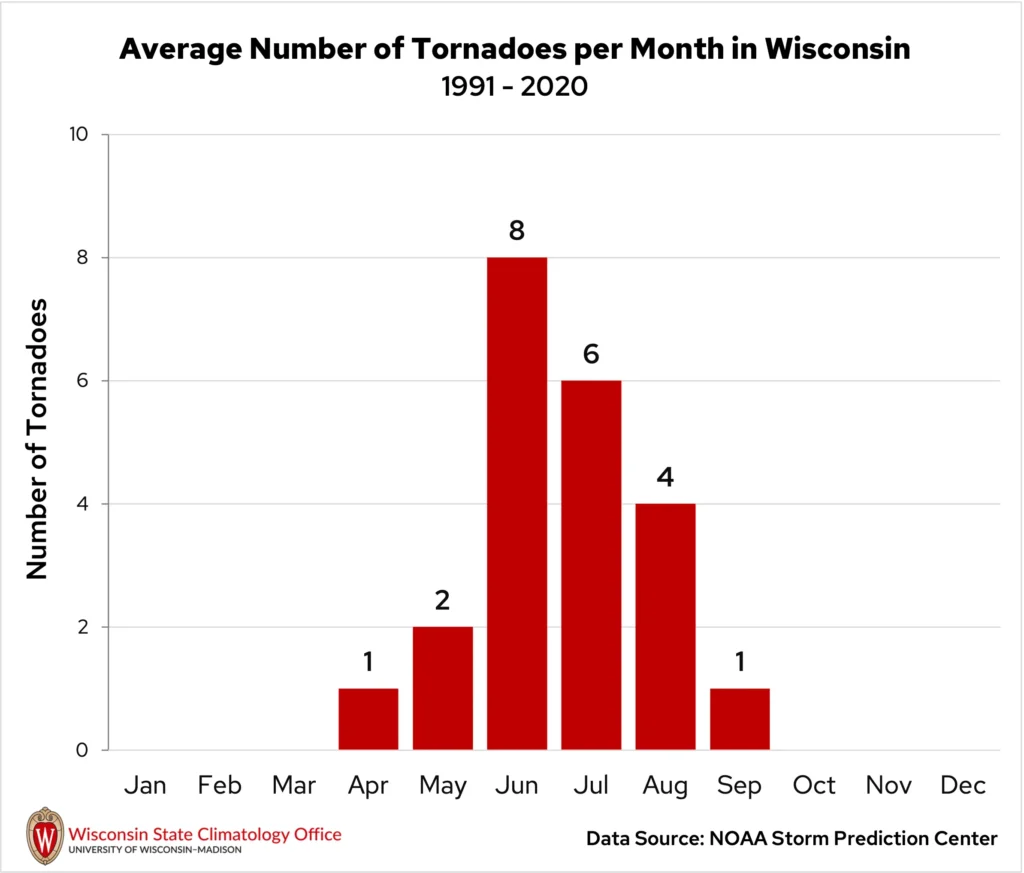
An average of 23 tornadoes have occurred in Wisconsin each year since 1981.
The most tornadoes in a single year occurred in 2005, when 62 tornadoes crossed the state. Nearly half of those came during the largest single-day outbreak in state history on August 18, 2005, when 27 tornadoes touched down.
In more recent years, 2024 had the third-highest annual count with 45, including the state’s first tornadoes recorded in February. A tornado has now been recorded in Wisconsin during each month of the year, with reliable records dating back to 1950.
| Most Wisconsin tornadoes in one day | Most Wisconsin tornadoes in one month | Most Wisconsin tornadoes in one year |
| 27 on August 18, 2005 | 30 in June 2005 | 63 in 2005 |
| 24 on May 8, 1988 | 27 in April 2026, June 1993 | 46 in 2010 |
| 22 on July 3, 1983 | 25 in July 1983 | 43 in 1980 |
Measuring Tornado Strength
Tornadoes are categorized by the Enhanced Fujita (EF) scale, using estimated wind speeds to rate the intensity of the storm. The National Weather Service rates each tornado on the 0-5 scale after surveying the storm path and estimating the strength of the wind that would have been required to create the damage seen.
Most Wisconsin tornadoes fall on the lower end of the EF scale as an EF0 (winds of 65-85 mph) or EF1 (winds of 86-110 mph). Less than two percent of the Badger State’s tornadoes have been ranked as EF4 or 5, and none have occurred in the 21st century.
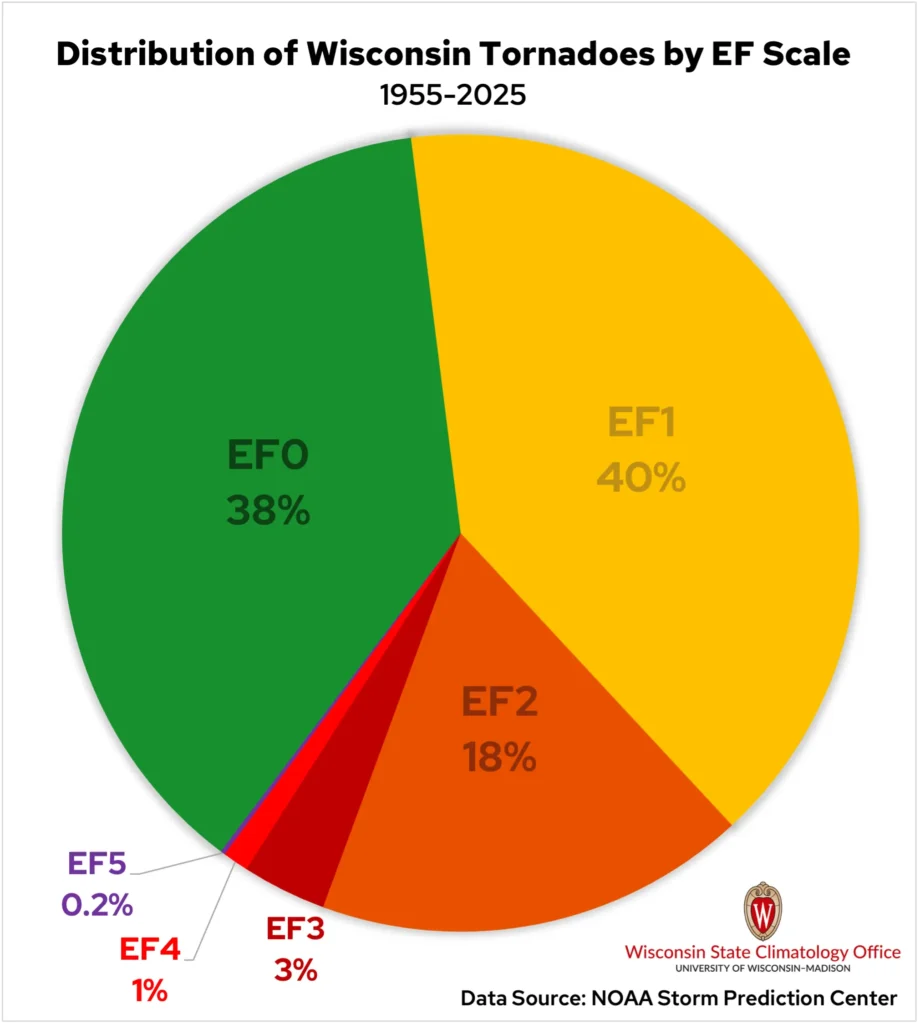
Since official records began in 1950, only three EF5 tornadoes have impacted Wisconsin: Colfax in 1958, Barneveld in 1984, and Oakfield in 1996. Before official records began, three other tornadoes in the state are estimated to have been EF5-strength, but are less thoroughly documented. These occurred in Darlington in 1893, Antigo in 1898, and New Richmond in 1899.
Taking Shelter
Tornadoes of all strengths can be destructive and potentially life-threatening. Weather alerts are issued by meteorologists at the National Weather Service ahead of and during severe weather events to keep the public safe.
When the National Weather Service expects tornadoes to occur in the coming hours, a “tornado watch” will be issued. Watches often cover multiple counties where meteorologists expect tornadoes to develop.
When meteorologists see signs of a tornado on radar, or one is reported by a storm spotter, a “tornado warning” will be issued. Warnings are issued only for the areas in the path of the potential tornado and last less than an hour.
When a tornado warning is issued, you may also hear outdoor sirens sounding. These sirens are intended to alert individuals who are outdoors that dangerous weather is imminent. You should not rely on sirens as a main form of alert, as they often cannot be heard indoors. Rather, download a local weather app, tune in to local news broadcasting, local radio, or use a weather radio to stay informed.
When a tornado warning is issued for your location, seek shelter indoors on the lowest level of the building, and stay away from windows. It’s a good idea to keep an emergency kit in the safe space of your home. Wait until the tornado warning has expired before emerging from your shelter.