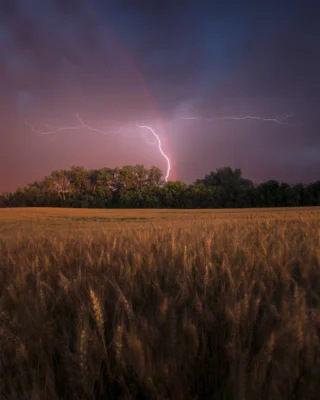
Summer in Wisconsin is often punctuated by flickers of lightning and rumbles of thunder. Many people assume that dangers from thunderstorms come only from events such as tornadoes, hurricane-strength winds, window-smashing hail, and flood-inducing rain.
Yet in the last 25 years, 13 lives have been lost in the state due to lightning. Thus, lightning should be considered dangerous, even if a thunderstorm has not been deemed to be severe.
What is Lightning?
Lightning is a brilliant flash of light produced by an electrical discharge — a rapid flow of energy in response to an electrical difference that develops between particles of opposite charge.
Typically, lightning is caused by a large electric charge separation within cumulonimbus clouds. These electrical charges can heat the air around them to 50,000 degrees Fahrenheit — five times hotter than the surface of the Sun! A single bolt, with an average diameter of about one inch, typically carries 300 million volts of electricity (just 120 volts powers a standard lightbulb).
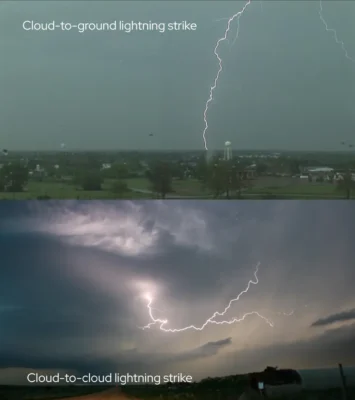
Lightning may occur between different portions of the cumulonimbus cloud (intra-cloud lightning), between clouds (cloud-to-cloud lightning), or between a cloud and an object on the ground (cloud-to-ground lightning).
Of all the lightning flashes observed around the world, only about 20 percent strike Earth’s surface as cloud-to-ground lightning, though this type of strike poses the largest threat to people, animals, and property.
Then Comes the Thunder
Thunder is heard after lightning is seen. This is partly because light travels about a million times faster than sound, but also because lightning creates thunder.
Thunder is a shock wave generated by lightning heating air to those hotter-than-the-sun temperatures. When heated to extraordinarily high temperatures, local air pressure increases abruptly. This creates a sound wave that’s heard as a clap of thunder.
The closer you are to a thunderstorm, the shorter the time interval between seeing the lightning and hearing the thunder. The sound of thunder generally takes about five seconds to travel one mile. You can estimate your distance from a storm by counting the number of seconds between when you see lightning and hear the thunder, then dividing by five. For example, if the elapsed time is 10 seconds, the lightning is two miles away. This can help you determine if a thunderstorm is moving toward or away from you.
If you see lightning, but don’t hear thunder, that means that you’re likely too far away for the sound to reach you. Such an occurrence has often been called heat lightning, a misnomer. Lightning can be seen as far as 100 miles away, but the accompanying thunder can only be heard from 10 miles away.
How is Lightning Tracked?
For centuries, the main way to assess lightning activity in a community was to keep track of the number of days when thunder was heard.
In the 1970s, lightning detectors were developed to sense the electromagnetic pulses or radio waves emitted by strikes and calculate the distance to the detector based on the signal strength. A network of lightning detectors can pinpoint the location and movement of cloud-to-ground lightning strikes using triangulation.
The National Lightning Detection Network, established in 1989, utilizes over 100 ground-based antennae and records each flash detected across nearly the entire United States.
With the advent of the National Weather Service’s Automated Surface Observing Systems in the mid-1990s, on-site lightning sensors helped expand lightning monitoring in the U.S.
Lightning Climatology
In Wisconsin, lightning is most common in July, followed by August. Over the last 30 years in Wisconsin, the average annual number of thunderstorm days has varied from 25 in the northeast to 40 in the south.
The greater number of thunderstorms over southern Wisconsin is associated with warmer and more humid conditions. Northern counties tend to have a more stable atmosphere due to the especially cool waters of Lake Superior.
Data collected between 2009 and 2018 indicate that Wisconsin averaged approximately 270,000 to 280,000 cloud-to-ground lightning flashes per year. However, some years are more active than others. In 2024, the National Lightning Detection Network counted over 2.1 million lightning events across Wisconsin, ranking the state 26th nationwide for total lightning events.
The Hazards of Lightning
The immense amount of energy and heat carried by a lightning strike makes it incredibly dangerous and sometimes deadly. Electrocution is caused by electric shock from the electric current in the lightning strike passing through the body. This can damage the skin or internal organs or cause cardiac arrest.
A bolt doesn’t have to strike a person directly to injure them. There are many different ways for the current of energy to conduct through different objects. Direct cloud-to-ground strikes to a person are less common but often the most deadly. Ground currents from nearby strikes occur more frequently and account for most lightning-related deaths and injuries.
Recent estimates indicate that 90 percent of individuals struck by lightning survive, but often sustain permanent injuries.
One of the deadliest incidents in Wisconsin’s recorded history occurred in the lakeshore community of Manitowoc on July 26, 1906. According to the Manitowoc County Historical Society, a lightning strike killed five people and injured four while they were attending a baseball game.
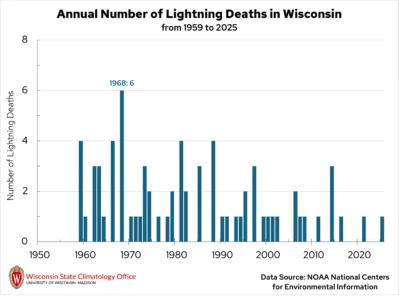
Since 1959, the number of lightning deaths has been decreasing due to the urbanization of society, improved weather communication, and increased public safety awareness. From 2000 to 2025, 13 lightning-related fatalities were reported in Wisconsin (averaging one every two years), while injuries totaled 74 (averaging three per year).
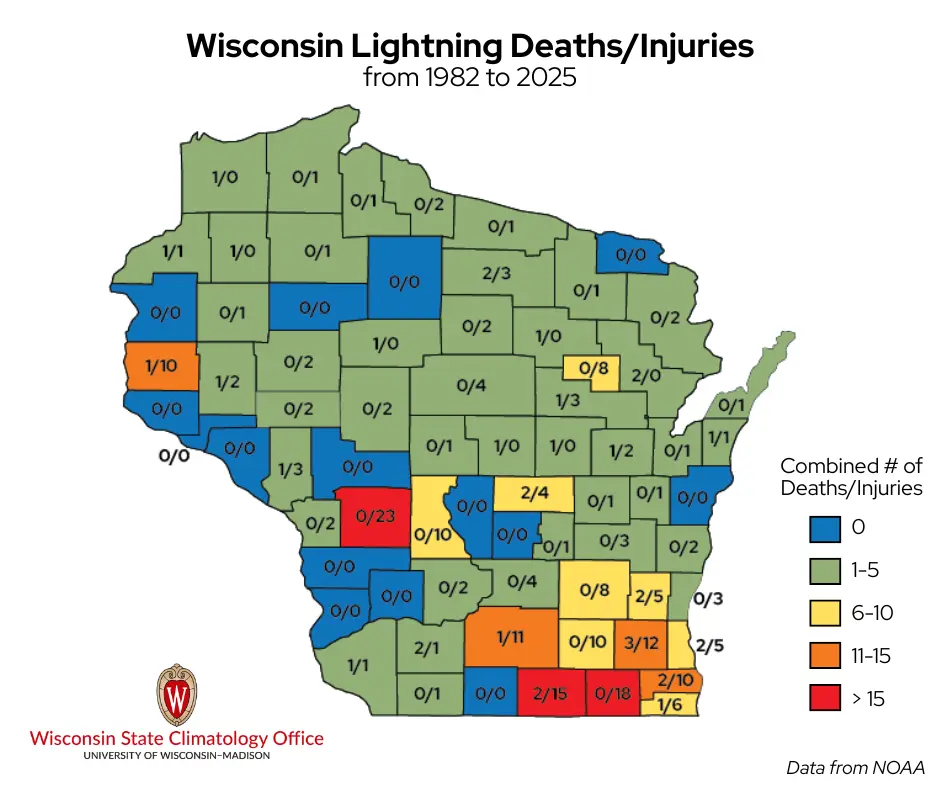
A map of Wisconsin shows the distribution of lightning events, casualties, and injuries between 1982 and 2025 according to NOAA. While the statistics are swayed by county size and population density, some of the spatial variation indicates more lightning incidents in southern Wisconsin, with fewer events in the north.
In addition to people, animals can be killed or injured by lightning. Around the nation, as many as 100,000 livestock are killed by lightning annually. Cattle are especially vulnerable because of their size and their proximity to metal fences or trees. Since Wisconsin is the Dairy State, the loss of dairy cows from lightning is a significant economic loss to farmers.
Protection from Lightning
You may have heard the phrase, “When thunder roars, go indoors!” because lightning can strike the ground up to 10 miles beyond the parent thunderstorm. You should not wait until rain begins falling to seek shelter in a safe place indoors. Even after the storm appears to have passed, it’s recommended to remain indoors for at least another 30 minutes.
Lightning is most dangerous when it strikes something that easily conducts electricity, such as metal objects. The current of energy often follows the shortest path between the cloud and the ground, such as high terrain, trees, and tall structures. Since most lightning injuries occur outdoors, it’s best to seek shelter in a fully enclosed building.
Contrary to popular opinion, vehicle tires provide little to no protection from lightning. Rather, safety comes from the metal roof of the vehicle. It acts as a pathway that directs the electrical current through the outer shell, through the tires, and into the ground. While passengers are generally protected inside a closed vehicle, lightning can damage antennas and electrical systems and may even ignite a fire.
The Pros of Lightning
Although lightning is dangerous, it serves its own purpose in our environment.
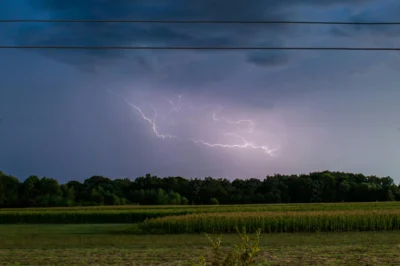
Lightning flashes produce natural fertilizer for plants through nitrogen fixation. The intense heat of a lightning bolt splits nitrogen molecules, which then bond with oxygen molecules to form nitrogen oxides. These oxides react with rainwater to form nitrous and nitric acids, which subsequently turn into nitrates. Plants absorb nitrates through their roots to produce essential proteins.
Without lightning, the electrical balance of Earth’s atmosphere would disappear in as little as five minutes. Lightning is generally negatively charged; thunderstorms keep the atmosphere positively charged by transferring negative charges back to the Earth’s surface. If this balance were not maintained, the fundamental “battery” that powers atmospheric processes would fail. This would lead to the rapid decay of the electric field that shields the surface and affects biological systems, such as navigation and circadian rhythm in animals.
Thunderstorms in Wisconsin’s Future
As Wisconsin’s climate becomes warmer and wetter, the storm season has expanded. Thunderstorms now occur more frequently during March and September.
The National Lightning Detection Network has monitored the annual variability of lightning strike frequency and density, especially in spring and summer, which appear to be associated with prevailing weather patterns in those seasons. Thus, changes in lightning frequency and location can be an indicator of climate change.
This report is a product of the Wisconsin State Climatology Office. For questions and comments, please contact us by email (stclim@aos.wisc.edu) or phone (608-263-2374).